Structural geometry often has a greater impact on embodied carbon than material substitution. Drawing on research from John SISK & Son, this article explores why decisions made during concept design, such as structural grids and span lengths, can outweigh later product choices, and what that means for engineers aiming to reduce whole-life carbon.

SISK's research highlights why early structural decisions have such a large carbon impact. For a medium-rise office, a 6 × 6 metre structural grid resulted in 77 kgCO₂e/m², compared with 196 kgCO₂e/m² for a 12 × 9 metre grid. These differences reflect the structural demands of longer spans: slabs become deeper, reinforcement increases, and supporting members grow accordingly. Rather than increasing in proportion to span, embodied carbon rises much more rapidly. For the flat slab configurations presented by SISK, increasing the span from 6 to 7.5 metres roughly doubled embodied carbon per bay, while increasing it to 9 metres roughly doubled it again.
None of this appears on an Environmental Product Declaration (EPD), because it is not a product property. It is a design property, which is why guidance from the Institution of Structural Engineers on calculating embodied carbon puts structural efficiency alongside specification. Less stuff, less cost. Now it is also less carbon.
Manufacturing decision-makers: What a Tier 1 contractor checks before your product gets specified, and how to stay on a shortlist
Data beats design instinct
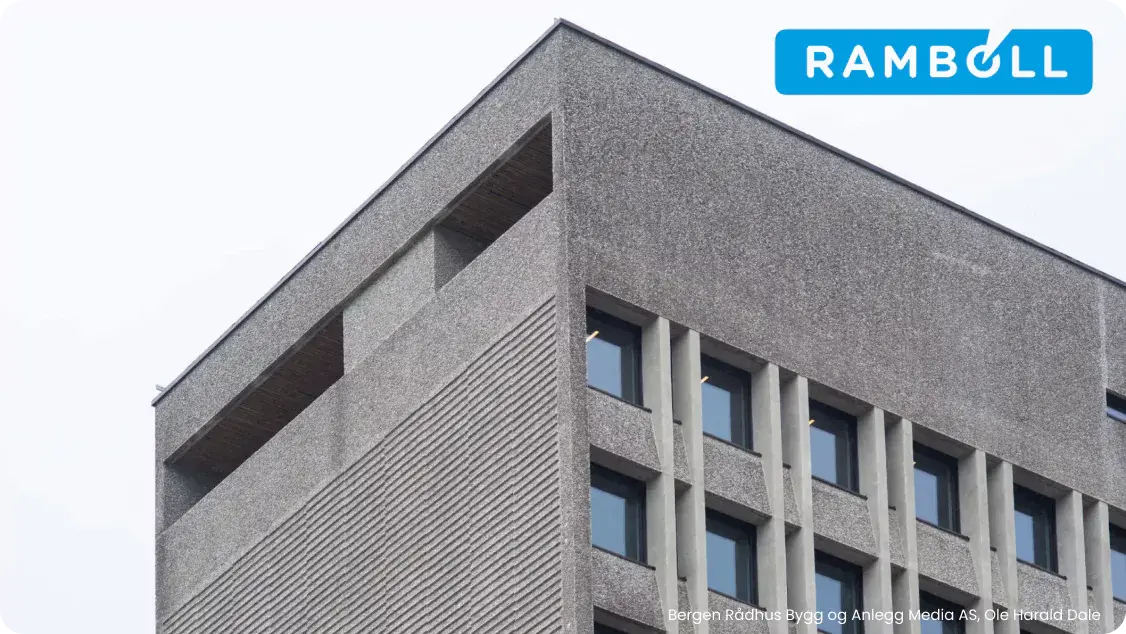
Assumptions about material performance can be misleading without whole-life assessment. In one study, SISK compared a façade incorporating 650 mm-deep terracotta fins with alternative façade solutions using different materials. The option with the lowest embodied carbon was a precast concrete spandrel, contrary to the team's initial expectations.
“We read the calculations a few times because it didn’t make sense that concrete would be lower carbon, but it’s because the alternatives were terracotta that needs high temperature to be manufactured and aluminium, which is also carbon intensive.”
- Juan A. Morillas, Head of Sustainable Design at John SISK & Son
The result illustrates how unreliable intuition can be when assessing embodied carbon. Assumptions about one building element can easily extend to frames, cores, or façades, reinforcing the need to test options with life cycle assessment rather than relying on experience alone
“We don’t talk about opinions. I don’t think we ever talk about opinions. It’s always data. So if you don’t have data to back it up, it doesn’t matter because it’s just talk.”
- Juan A. Morillas, Head of Sustainable Design at John SISK & Son
On one retrofit project, SISK tested a proposal for triple glazing by holding the building design constant and changing only the window specification in its life cycle assessment model. This isolated the impact of the glazing on embodied carbon, operational carbon and whole-life cost, allowing the team to evaluate the trade-offs before making a design decision.
Translating carbon into engineering metrics
"Carbon is an abstract measurement," Juan A. Morillas observed. While few clients or project teams have an intuitive understanding of a tonne of CO₂e, they are familiar with quantities such as steel tonnage and concrete volume. SISK therefore reports these metrics alongside embodied carbon, helping project teams understand how structural efficiency translates into carbon performance.
This approach makes carbon data easier to use in design discussions. Rather than treating embodied carbon as a standalone sustainability metric, teams can relate it directly to engineering decisions that influence material quantities. With embodied carbon accounting for around 20% of UK built environment emissions, according to the UK Green Building Council (UKGBC), presenting results in familiar engineering terms can help build consensus and support better-informed design decisions
Tip: price the grid in carbon first
Compare structural grids and frames from minimal data with early design decarbonisation tools, then pressure-test product choices with Materials Compass.
Why early design has the greatest carbon influence
The opportunity to reduce embodied carbon decreases rapidly as a project progresses. By the early stages of the RIBA Plan of Work, key structural decisions,such as the grid, span lengths, and structural system,are often established. After tender or Stage 3, changing these elements becomes increasingly difficult. As Juan A. Morillas explained: "It's very difficult to go on a project post tender or Stage 3 and change the grid."
By that stage, project teams are often focused on refining material specifications rather than revisiting the decisions that determine how much material the building requires. Reflecting on the design process, Morillas noted:
“The more you leave it to the end, and I think we’ve all been there, when you get into here, post tender, you spend a lot of time arguing, weekly meeting minutes, arguing about minor reductions on carbon and cost, whilst the impact is here.”
- Juan A. Morillas, Head of Sustainable Design at John SISK & Son
His point was not that contractors should lead concept design, but that they should contribute to it. Bringing construction, structural and sustainability expertise into early design discussions allows teams to compare options while the biggest carbon decisions are still open.
For many projects, this means shifting effort from product optimisation to design optimisation. Material substitutions remain valuable, but their impact is often constrained once the structural grid, transfer structures, and basement extent have been fixed. Early-stage carbon assessments help quantify these design choices before they become difficult or impossible to change.
“When you do things efficient and applying common sense, you usually get the carbon down, but also the cost and the programme.”
- Juan A. Morillas, Head of Sustainable Design at John SISK & Son
The alignment between structural efficiency, cost and embodied carbon is one of the strongest arguments for assessing carbon early. Rather than treating carbon as a separate sustainability exercise, project teams can use it alongside engineering and commercial considerations to compare structural options while meaningful changes are still possible
Manufacturer Pages: Get your construction materials in front of AEC professionals through Materials Compass, a 500,000+ construction materials database
FAQ
Does the structural grid affect embodied carbon?
Yes, strongly. SISK’s research found a 6x6m office grid produces 77 kgCO2e/m2 while a 12x9m grid produces 196 kgCO2e/m2, and embodied carbon grows exponentially with span. Early design tools such as One Click LCA’s Carbon Designer let teams quantify grid options before they are fixed.
What cuts more embodied carbon, design optimisation or material substitution?
Design optimisation usually cuts more. Changing spans, layouts, and structural logic can halve embodied carbon, while material swaps typically deliver single-digit to low double-digit savings. One Click LCA supports both, letting teams compare design and material options in one assessment.
When should embodied carbon be assessed in a project?
As early as possible, ideally before the structural grid is fixed at concept design. After tender or RIBA Stage 3, grid changes become impractical and only marginal savings remain. One Click LCA’s early design tools produce carbon comparisons from minimal data in the earliest stages.
Why did concrete beat terracotta on embodied carbon in SISK’s facade study?
Because terracotta requires high-temperature manufacturing and aluminium alternatives are also carbon intensive, a precast concrete spandrel had the lowest embodied carbon of the options studied. Life cycle assessment data in tools like One Click LCA reveals such counterintuitive results reliably.
Carbon Experts Newsletter
Industry news & insights — straight to your inbox
Want to learn more?
Justyna Michalik-Minken • Sept 18 2026
Justyna Michalik-Minken • Jul 06 2026

Justyna Michalik-Minken • Sept 18 2026

Justyna Michalik-Minken • Jul 10 2026