Steel remains one of the most carbon-intensive materials used in construction. International steel manufacturer SSAB reports that steel production accounts for around a quarter of global industrial CO₂ emissions. If the steel sector was treated as a country, it would rank among the largest emitters globally. For manufacturers and specifiers, this places steel firmly at the centre of whole-life carbon reduction strategies.
At the 2025 Carbon Experts Summit London, specialist steel manufacturer and distributor Firth Steels and SSAB presented a data-led collaboration demonstrating how upstream steel decarbonisation, when combined with verified product data, can deliver measurable embodied carbon reductions at system and project level.
Their analysis combines low-carbon steel production data with system-level environmental product declarations (EPDs) produced using One Click LCA, enabling comparison, specification, and compliance at building scale.
This article examines what that collaboration shows in practice and why it matters for procurement, specification, and compliance in the UK and beyond.
Where the carbon impact sits: Evidence from Scope 3 reporting
Firth Steels, an independently owned UK manufacturer founded in 1983 and based in Brighouse, Yorkshire, supplies building envelope and structural decking systems to the UK and export markets. Through Planet Mark Business Certification, the company quantified its full Scope 1, 2, and 3 emissions.
For the 2023 reporting year, Firth Steels recorded a total market-based carbon footprint of almost 50,000 tCO₂e. Scope 3 accounted for 99.7% of these emissions, emerging mainly from purchased goods and services. Steel alone contributed more than 47,000 tCO₂e, equivalent to 99% of emissions within that category.
Why this matters for Scope 3 reporting
These figures illustrate a pattern common across steel-intensive manufacturing: operational efficiencies can deliver incremental savings, but meaningful reductions depend on material choice upstream. Without lower-carbon steel, Scope 3 trajectories remain largely fixed.
Limits of conventional steelmaking
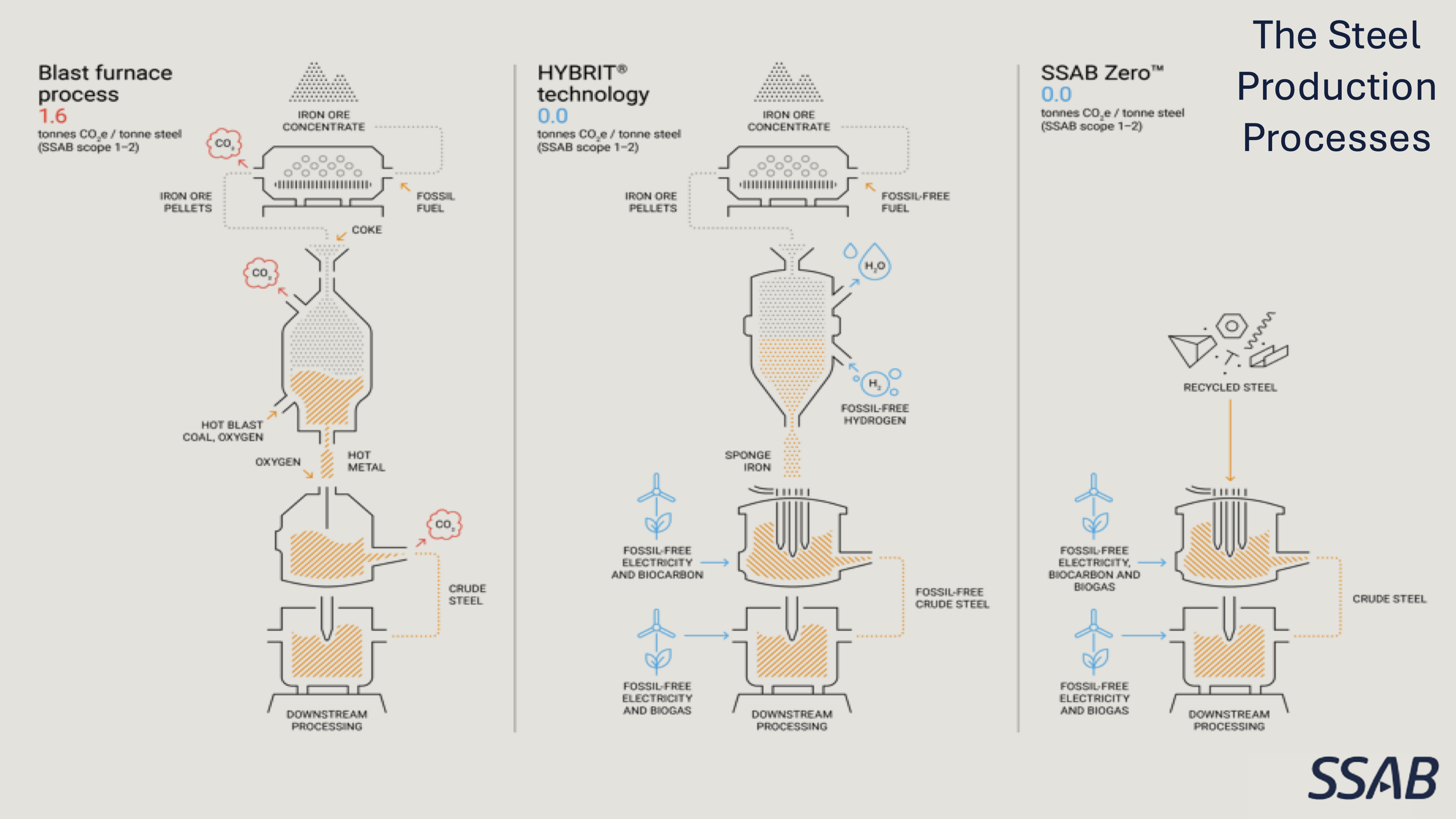
Traditional blast furnace steel production relies on coal-based reduction and fossil fuels, resulting in high emissions per tonne of output. According to SSAB’s comparison of global blast furnace steel production, the average production intensity is approximately 2,000 kg CO₂ per tonne of crude steel, based on industry benchmarking of conventional BF–BOF routes versus SSAB’s own production performance.
At a national scale, this intensity has systemic implications. SSAB reports that its historical operations accounted for approximately 10% of Sweden’s total CO₂ emissions and around 7% of Finland’s, highlighting both the scale of the challenge and the potential impact of producer-level transformation when lower-carbon steelmaking routes are deployed.
“If the steel industry were measured as a country, it would rank as the fifth-largest emitter in the world. That scale of impact is exactly why transforming steel production matters” — said Gary Matthews at SSAB
Two routes to lower-carbon steel at scale
SSAB’s decarbonisation strategy focuses on eliminating fossil carbon from steel production through two complementary pathways.
“SSAB Zero™ is the first commercially available steel produced from recycled material using fossil-free energy, with virtually zero fossil carbon emissions” — said Gary Matthews, SSAB
SSAB Zero™
SSAB Zero is produced from high-quality recycled scrap, using fossil-free electricity and fuels. It is described by SSAB as a virtually zero fossil carbon emissions product, making it immediately applicable where scrap-based routes are suitable.
HYBRIT fossil-free steel
HYBRIT replaces coal with hydrogen for iron ore reduction. This change results in emissions of around 25 kg CO₂ per tonne of crude steel, instead of the approximately 2,000 kg CO₂ global average. The process is enabled by access to fossil-free electricity in northern Sweden.
What this means for procurement teams
These routes make low-carbon steel a market reality, allowing manufacturers to specify verified lower-carbon inputs without relying on offsets or future developments.
From claims to comparability: The role of EPDs
Decarbonised steel only becomes actionable when its impact can be quantified, compared, and specified. In this collaboration, environmental product declarations (EPDs) produced using One Click LCA translate upstream steel decarbonisation into comparable, product- and system-level metrics.
This step is critical. EPDs allow specifiers to compare steel systems on a like-for-like basis, assess impacts across life cycle stages, and integrate results into building-level whole life carbon assessments.
Verified outcomes at system level — up to a 74% reduction
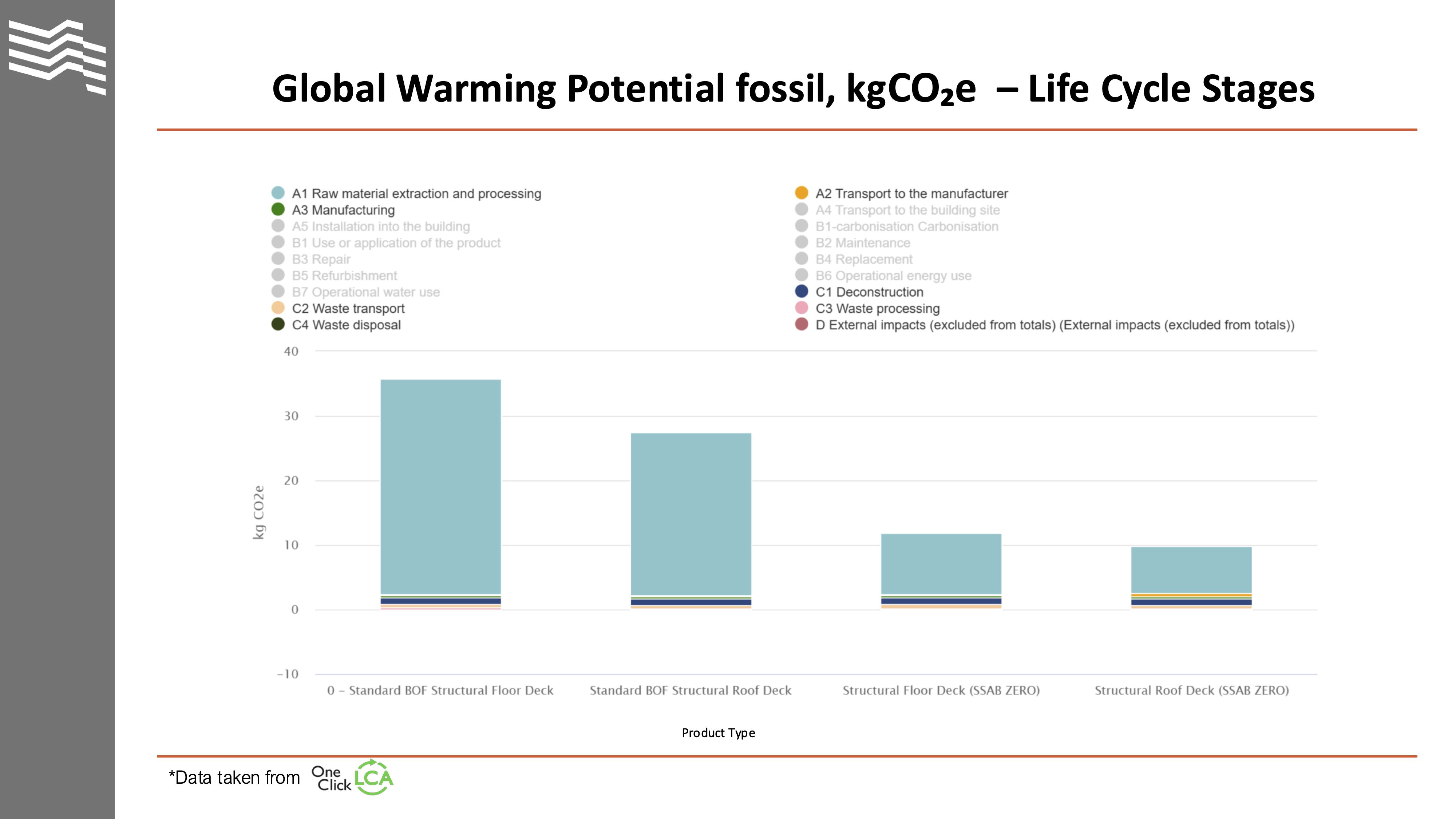
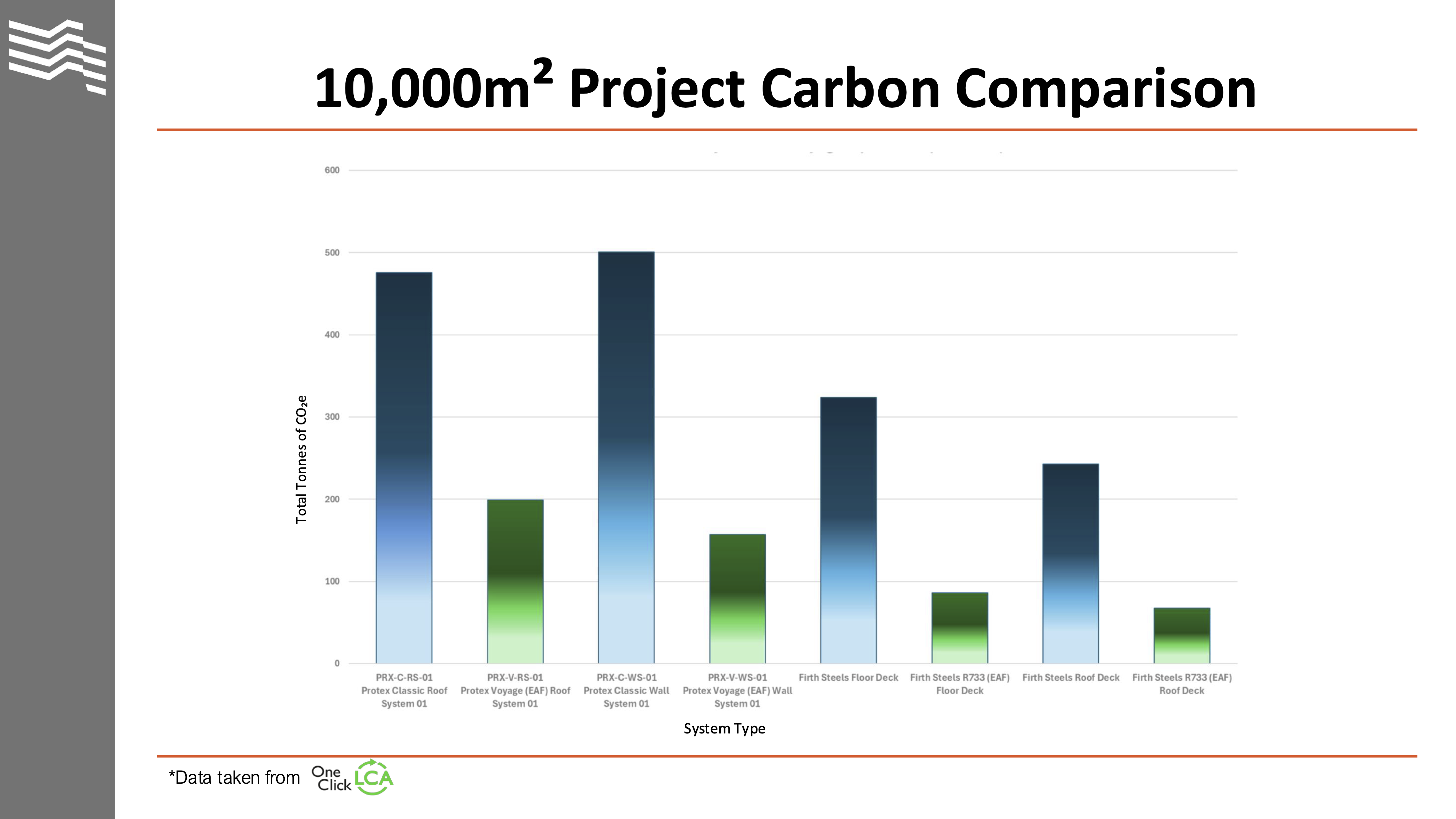
Using verified EPD data generated through One Click LCA, Firth Steels assessed multiple real-world building systems, comparing conventional steel inputs with lower-carbon electric arc furnace (EAF) and SSAB steel routes. The comparisons were carried out at system level, using consistent areas and system configurations, reflecting how products are specified and assessed in practice.
Results are expressed in kgCO₂e per square metre and total tonnes of CO₂e, enabling direct use in whole building life cycle assessments and carbon budgeting exercises.
These system-level outcomes support the wider shift toward low-carbon steel pathway outlined in IEA Iron and Steel Technology Roadmap.
Building envelope systems (8,000 m²)
Nearly 60% lower embodied carbon across roof and wall systems
Roof and wall systems both delivered close to a 60% reduction in global warming potential (GWP) when lower-carbon steel was used.
Roof systems:
Global warming potential was reduced from 48.1 to 19.9 kgCO₂e/m², representing a 58% reduction. Across an 8,000 m² roof area, this equates to a total saving of 221.6 tCO₂e.
Wall systems:
GWP was reduced from 37.7 to 15.7 kgCO₂e/m², also a 58% reduction, delivering a total saving of 174.4 tCO₂e over the same system area.
Structural decking
More than 70% embodied carbon reduction in structural decking systems
Structural decking systems achieved reductions of over 70% in embodied carbon, with particularly strong results for floor decking.
Floor deck (583 m²):
GWP was reduced from 25.9 to 6.7 kgCO₂e/m², a 74% reduction, equating to 11.2 tCO₂e saved.
Roof deck (500 m²):
GWP was reduced from 24.3 to 6.76 kgCO₂e/m², a 72% reduction, delivering a saving of 17.5 tCO₂e.
“What this project demonstrated is that significant embodied carbon reductions can be achieved using commercially available steel today, without changing system performance, compliance, or buildability.” — said Sam Hopton at Firth Steels
Why this matters for specification
“For Firth Steels, almost all of our carbon footprint sits in Scope 3, so the biggest lever for change is the steel we specify and source” — said Sam Hopton, Firth Steels
For specifiers, this shifts embodied carbon reduction away from downstream optimisation and towards upstream material selection, where the greatest impact can be achieved.
Presenting results in kgCO₂e/m² and total tonnes saved allows design teams to substitute systems directly within whole building LCAs, BREEAM assessments, and RICS-aligned reporting. This enables embodied carbon reductions to be delivered through material and system selection, rather than relying on downstream mitigation measures.
Compliance context: UK direction, global relevance, and the role of LCA
In the UK, Approved Document L regulates operational energy performance but does not set requirements for embodied carbon. As a result, whole-life carbon is currently driven by client requirements, planning policy, and industry frameworks, rather than mandatory building regulations.
However, expectations are tightening. BREEAM v7 places increased emphasis on whole-life carbon assessment and product-level data quality, reinforcing the need for verified EPDs in material specification. In parallel, the RICS Whole Life Carbon Assessment (2nd edition) provides a consistent methodology for assessing and reporting embodied and operational carbon across building life cycles, and is increasingly referenced by clients and planning authorities.
Part Z proposals signal a potential policy move towards mandatory whole-life carbon assessments and embodied carbon limits in the future, while the UK Net Zero Carbon Buildings Standard establishes a shared framework for defining and reporting net zero carbon buildings across the industry.
Internationally, the revised EU Construction Products Regulation and the introduction of Digital Product Passports point towards greater requirements for standardised, digital product carbon data, affecting manufacturers and projects operating across borders.
How LCA data is used in practice
Verified EPDs produced using One Click LCA enable manufacturers, specifiers and project teams to meet compliance and client requirements. Product-level carbon data can be directly integrated into whole building LCAs, supporting BREEAM assessments, RICS-aligned reporting, client ESG disclosures, and future regulatory readiness — without the need to retrofit data under time or compliance pressure.
Frequently asked questions about decarbonisation of steel in construction
What is embodied carbon and why is steel such a priority material?
Embodied carbon refers to emissions across a material’s life cycle, from raw material extraction to end of life. Steel is a major contributor, and One Click LCA-enabled data shows purchased steel is the main contributor for Firth Steels’ Scope 3 emissions.
What does low-carbon or fossil-free steel mean in practice?
Low-carbon steel is produced with significantly reduced fossil fuel use. SSAB Zero uses recycled scrap and fossil-free energy, while SSAB HYBRIT replaces coal with hydrogen in iron ore reduction.
How much carbon reduction can low-carbon steel deliver at system level?
Using EPDs generated withOne Click LCA, Firth Steels demonstrated embodied carbon reductions of 58% for roof and wall systems and up to 74% for structural decking.
How does One Click LCA support steel system specification at scale?
Steel carbon reductions are verified through independently reviewed environmental product declarations. One Click LCA enables Firth Steels and SSAB to publish comparable, standardised data for whole life carbon assessment.
Does switching to low-carbon steel affect performance or design?
Switching to low-carbon steel does not affect system performance or design. Firth Steels’ reductions come from SSAB’s steel production route, enabling like-for-like specification with lower embodied carbon.
How does low-carbon steel support UK and global compliance requirements?
EPD data produced with One Click LCA supports UK whole-life carbon reporting, client ESG requirements, and frameworks such as the UK Net Zero Carbon Buildings Standard, while remaining applicable to global projects.