
The UK government has announced what they called the “fastest infrastructure building in a generation". From July 24, 2026, mandatory pre-application consultation for Nationally Significant Infrastructure Projects (NSIPs) is scrapped, removing up to 12 months from the planning process and saving industry an estimated £1 billion this Parliament. The government targets at least 150 major infrastructure decisions before the next election, nearly triple the 59 Development Consent Order decisions of the previous Parliament, feeding a national pipeline of 734 projects worth £718 billion.
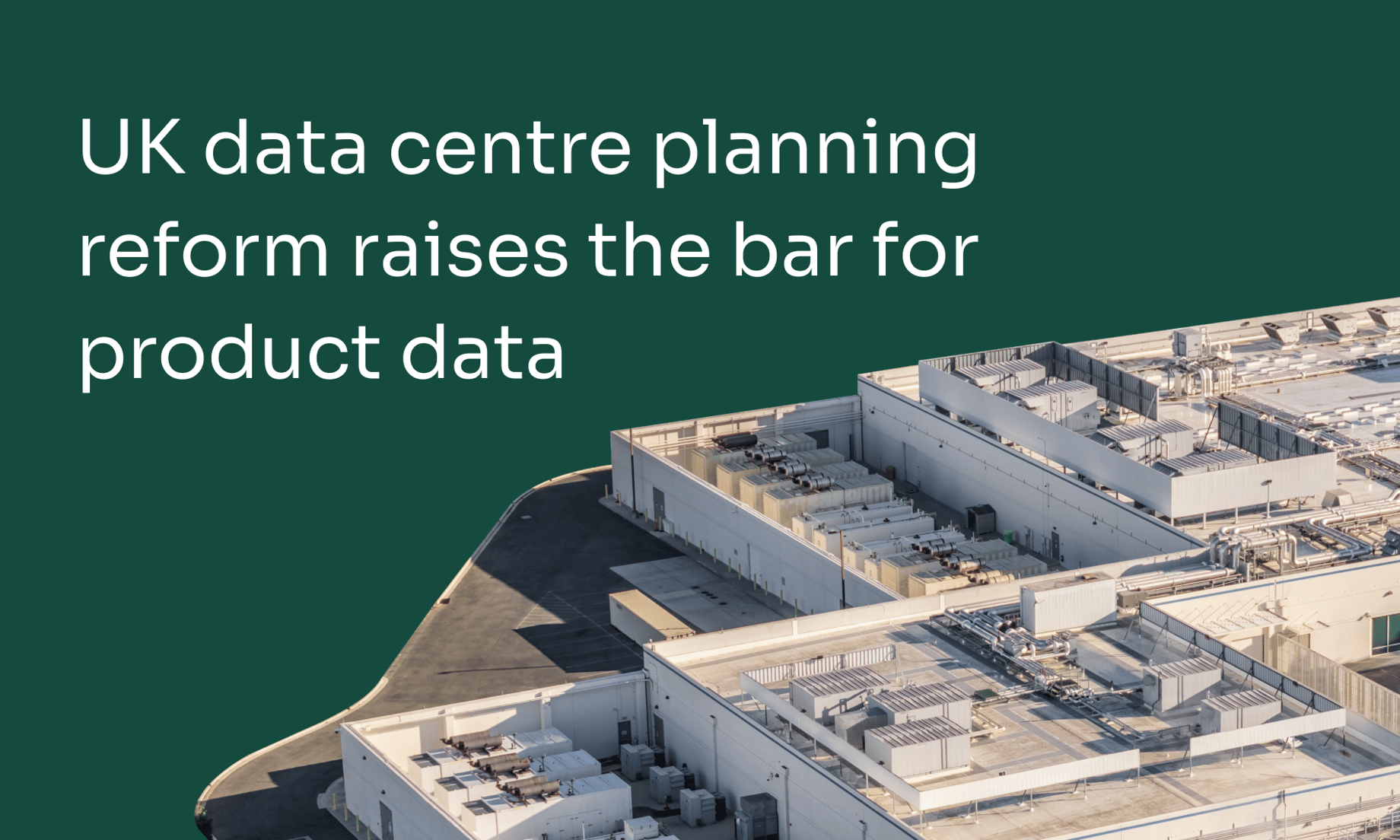
The biggest change may not be planning itself, but the pace of procurement. Manufacturers aiming to be specified in these critical projects could face earlier requests and shorter deadlines to provide product information.
Three data centres are already in the fast lane
Buried in the announcement is a detail with direct implications for companies supplying construction products.. Data centres can now opt in to the NSIP regime, gaining access to strict, fixed decision timeframes instead of uncertain local determination. Ministers have already directed three data centre proposals into the regime: Wapseys Wood in Buckinghamshire, Ampthill Road in Bedford, and New Barn Lane in Dartford.
This changes who is the final customer, and their set of requirements. A data centre consented through the NSIP route is typically built for, or pre-let to, a hyperscale operator (like Amazon, Microsoft, Google, and Meta). These clients bring procurement standards that differ sharply from the domestic construction market, and they apply them to every tonne of concrete, steel, cable, and cooling equipment that enters the site.
What hyperscale procurement requires
Hyperscale operators carry public, science-based decarbonisation commitments, and embodied carbon in construction materials sits squarely inside their scope 3 targets. The requirements are already contractual, not aspirational.
Microsoft has updated its datacenter contract language to include low-carbon requirements for construction materials and equipment. At the same time, it has shifted its carbon accounting for major building materials to third-party verified Environmental Product Declarations (EPDs). The company is testing concrete mixes designed to halve embodied carbon dioxide emissions, and piloting structural alternatives that cut embodied carbon by 35% against conventional steel builds. Despite its efforts, the company recently reported that its emissions surged 25% in 2025 due to the data centre consumption. Reducing embedded carbon in the data centre construction rather than focusing only on operative emissions can help these hyperscalers to reach their climate targets.
Public procurement is also becoming more prescriptive. The U.S. General Services Administration, for example, sets quantified benchmarks: for instance, rebar landing between 611 and 760 kg CO2e per tonne, hot-rolled sections between 686 and 869 kg CO2e per tonne. You cannot demonstrate performance against numbers like these with an industry-average dataset. Only product-specific, independently verified data qualifies.
Manufacturer Pages: Reach specifiers searching the world's largest product LCA database
The UK policy environment also reinforces this kind of criteria. The Construction Products Reform White Paper, published in February 2026, proposes that designated-standard products carry digital environmental performance information, with Environmental Product Declarations backed as the common format for presenting life cycle results. Public clients procuring the wider NSIP pipeline already require carbon management aligned with PAS 2080 from National Highways Tier 1 and Tier 2 suppliers, and Carbon Reduction Plans for public contracts above £5 million. Whether your product ends up in a data hall, a reservoir, or a rail scheme, the evidence requirement converges on the same document.
Industry-average data can cost you the tender
Generic industry data describes what an average manufacturer produces. It cannot describe what you produce, and it cannot capture the investments you have made in cleaner energy, alternative raw materials, or process efficiency. When a hyperscaler compares two suppliers, one holding a product-specific verified Environmental Product Declaration (EPD) and one pointing to a sector average, the first supplier offers auditable evidence that flows directly into the client's carbon accounting. The second offers only an estimate the client must caveat. Procurement teams working against science-based targets avoid non-verified claims
The reverse is also true, and it presents an opportunity. If your product performs better than the industry average, an EPD lets you prove it, get that advantage recognised with life cycle data, and convert carbon performance into specification wins. In a market where product availability is healthy but demand is subdued, verified environmental performance is one of the few differentiators that survives price competition.
Tip: GET EPD-READY BEFORE TENDERS ASK
Start with One Click LCA’s simple guide to Environmental Product Declarations, then create verified declarations at scale with the EPD Generator.
What to do before the pipeline accelerates
Three actions determine whether your products are ready when these projects reach procurement.
- Map your exposure. Identify which product lines serve data centre, energy, and transport construction, and check whether each carries a current, third-party verified EPD compliant with EN 15804 and ISO 14025. Expired or generic declarations will not pass hyperscaler due diligence.
- Close the gaps at portfolio scale. Manufacturers with wide product ranges cannot afford consultant-led, one-at-a-time EPD projects on the timelines this pipeline now demands. Software-based EPD generation compresses production from months to weeks and keeps declarations current as inputs change.
- Make your data usable at an early design stage. Earlier technical input from the Planning Inspectorate means design teams decide on material strategies sooner. Specifiers pull verified product data directly into life cycle assessment tools during design development. If your products are not in the databases they use, you are designed out before the tender exists.
EPD Generator: Publish EPDs 10x faster and scale across your entire portfolio
One Click LCA supports each step: EPD creation verified against 140+ standards and methods, publication into the world's largest construction LCA database with 500,000+ datasets used by specifiers in 170+ countries, and integrations with 20+ design and modeling tools, including Autodesk and Bentley Systems. Manufacturers like ArcelorMittal and Saint-Gobain already use the platform to turn product carbon data into a commercial asset.
The UK planning reform has shortened the runway. The projects are coming faster, the clients demand verified data, and the manufacturers who can evidence their carbon performance will be the ones specified into them.
UKNZCBS in practice: Five practical lessons on procurement, as-built data, and material reuse for AEC teams from real UK construction projects
Frequently asked questions
What did the UK Planning and Infrastructure Act change for data centres?
The Planning and Infrastructure Act 2025 allows data centres to opt in to the Nationally Significant Infrastructure Project (NSIP) regime, giving them fixed decision timeframes instead of local determination. From July 24, 2026, mandatory pre-application consultation is removed, cutting up to 12 months from consenting. Three proposals have already entered the regime: Wapseys Wood, Ampthill Road, and New Barn Lane.
What is an Environmental Product Declaration (EPD)?
An Environmental Product Declaration (EPD) is a third-party verified document that reports the environmental impacts of a product across its life cycle, based on a life cycle assessment conducted to EN 15804 and ISO 14025. Manufacturers use platforms such as One Click LCA, the world's largest life cycle assessment platform, to create and verify EPDs against 140+ standards and methods.
Do data centre construction projects require EPDs?
Increasingly, yes. Hyperscale operators embed low-carbon material requirements in construction contracts; Microsoft, for example, accounts for embodied carbon using third-party verified EPDs. Suppliers without product-specific verified data cannot demonstrate performance against embodied carbon benchmarks, so manufacturers create EPDs with tools such as One Click LCA to remain specifiable in these tenders.
What carbon requirements apply to UK infrastructure suppliers in 2026?
Public clients require carbon management aligned with PAS 2080 across National Highways Tier 1 and Tier 2 suppliers, Carbon Reduction Plans for public contracts above £5 million, and the Construction Products Reform White Paper backs EPDs as the common format for product environmental information. One Click LCA supports compliance with these frameworks alongside 140+ other standards and methods.
How long does it take to create an EPD?
A consultant-led EPD can take several months per product, plus external verification. Software-based EPD generation with One Click LCA compresses this to weeks, including third-party verification, and lets manufacturers update declarations as recipes, suppliers, or energy inputs change. This matters when a £718 billion infrastructure pipeline is moving to procurement on accelerated timelines.
How do specifiers find and use EPD data during design?
Design teams pull verified product data into life cycle assessment tools while comparing material options, well before tenders are issued. Products published in the databases specifiers use get evaluated, and those absent get designed out. One Click LCA's construction database holds 500,000+ datasets used in 170+ countries and integrates with 20+ design tools, including Autodesk and Bentley Systems.
Carbon Experts Newsletter
Industry news & insights — straight to your inbox
Want to learn more?

Asha Ramachandran • Oct 02 2024

Aileen Carroll • Sep 26 2024
.jpg)
Laura Drury • Sep 03 2024