/buildings_card-fourth.webp)
.jpg)
/menu_Company_Open-positions_card-fourth.webp)

Industry
Building Products Manufacturing
Company size
Headquarters
Results
Earlier carbon insight
Carbon evidence before lock-in
Integrating LCA into the quotation workflow gives teams carbon evidence while façade systems and specifications are still being evaluated.
Complete system comparison
Assess the whole façade system
Project teams can assess complete façade assemblies, including profiles, glazing, thermal breaks, and fixings, on a project-specific basis.
Traceable decision-making
Carbon evidence built into quotations
Each comparison ties to documented project assumptions, quantities, and environmental data, giving teams clearer evidence for decisions.
The challenge
Carbon information can arrive after the decisions it's meant to influence. By the time a manual assessment is complete, the façade system may already be selected, the specification written, and supplier offers under final comparison.
The solution
Hydro Building Systems integrated One Click LCA into its own quotation workflow, connecting project and product data with environmental assessment in the same process used to develop customer offers.
Outcome
Project teams can compare complete façade solutions and alternative configurations while design and procurement options remain open. Architects, consultants, and contractors receive carbon evidence early enough to use it in project decisions.
"Carbon data creates real value, but only when it's available early enough to support project decisions."
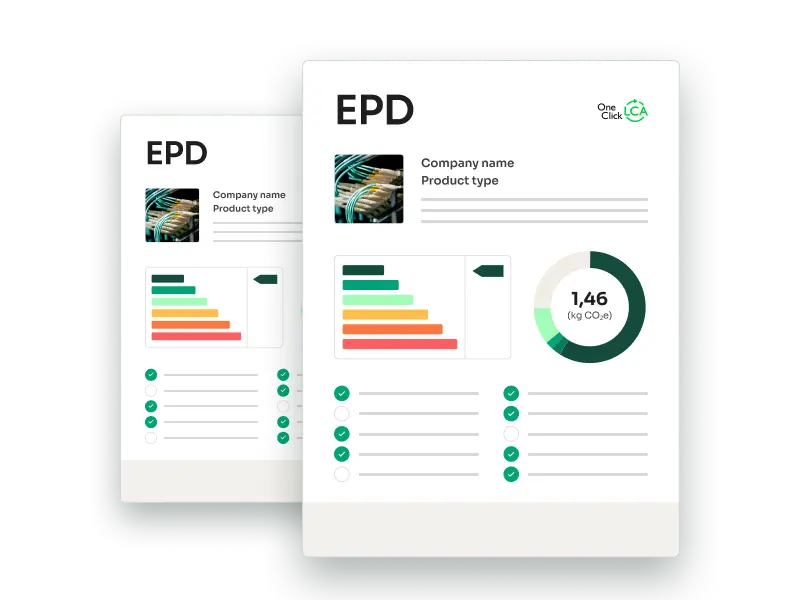
EPDs for your products :Create EPDs faster, across your entire portfolio.
Full story
As sustainability requirements become more important in construction, manufacturers are expected to provide more than technical product performance, customers increasingly need environmental information that can support specification, tender, procurement, and compliance decisions. For Hydro Building Systems, the central challenge was timing. Manual carbon assessments require teams to collect, validate, and calculate environmental data across multiple steps, and by the time the result is available, many of the decisions determining the project's environmental impact may already have been made, the façade system selected, the specification written, supplier offers already under comparison. At that point, carbon assessment becomes evidence of a decision rather than evidence for one. The challenge, then, was not simply whether Hydro could calculate environmental impact, but whether carbon, circularity, and material information could reach project teams early enough to influence the outcome.
Embed LCA into the quotation workflow
Hydro Building Systems worked with One Click LCA to integrate digital life cycle assessment directly into its existing quotation process. Instead of running environmental assessment as a separate expert exercise, the connected workflow brings together product information, project quantities, material data, and environmental datasets in the same process where commercial and technical options are already being evaluated. Hydro's quotation system provides the project and product context, while One Click LCA provides the environmental assessment layer needed to compare the resulting solutions.
Compare complete façade systems, not isolated products
A façade or window is rarely a single material, its environmental impact depends on profiles, glazing, thermal breaks, accessories, fixings, gaskets, coatings, quantities, and the specific configuration selected for the project. Hydro's integrated workflow lets teams assess that complete system rather than judging performance from the aluminum profile alone. That means project teams can compare different façade or window systems, alternative glazing and component configurations, different levels of recycled aluminum content, and project-specific renovation or design scenarios. The conversation can move from "which material has the lower footprint?" to "what is the impact of this complete façade solution for this project, and how does it compare with the alternatives?"
Bring carbon evidence into specification decisions
For a façade renovation, teams typically balance carbon alongside cost, aesthetics, technical performance, availability, compliance, and project risk. By integrating assessment into the quotation workflow, Hydro can provide environmental evidence while those trade-offs are still being considered, making carbon information part of the same commercial and technical conversation as the other factors influencing specification. The value isn't simply producing an LCA faster; it's making the result available at the point when the project can still change.
Traceability builds trust
Early information only helps if project teams can trust it. The integrated workflow documents the quantities, datasets, standards, and scenario assumptions behind each comparison, giving architects, consultants, contractors, and Hydro teams a clearer basis for understanding why one option performs differently from another and where the underlying result comes from. Rather than relying on generic sustainability claims, teams can discuss project-specific evidence with transparent assumptions.
What Hydro's approach shows
Hydro's approach centers on three principles: make environmental data usable, bringing carbon evidence into the workflows project teams already use; compare options early, evaluating complete systems while specifications and supplier choices can still change; and make assumptions traceable, documenting the data behind each comparison so decisions remain transparent and defensible. Together, these principles move carbon evidence from a compliance record toward a practical input into specification and procurement.
"Carbon data creates real value, but only when it's available early enough to support project decisions." — Lucile Souyri, Head of Sustainability, Hydro Building Systems

Carbon Experts Newsletter
Practical insights on LCA, EPDs, regulations and low-carbon construction — straight to your inbox.