

You expect your second EPD to take less time than the first. After all, the point of investing in software is to make the process faster, easier, and more scalable. Yet many manufacturers find their second Environmental Product Declaration takes almost as long as the first, and the process never improves much.
When that happens the costs accumulate. Every hour spent rebuilding models, re-entering data, or correcting avoidable errors is an extra cost. And when architects, contractors, and procurement teams require EPDs before they will specify or buy a product, a slow response can delay or risk market opportunities.
So how do you know when your EPD software is becoming a business bottleneck? Look for these ten warning signs:
Data and integration
1. Data collection takes longer than the modeling
Before your team can calculate a single impact, someone often has to gather the bill of materials, clean up the spreadsheets, and key the values into your current EPD software line by line. This data-gathering stage takes longer than the environmental calculations themselves, and it starts over with every new product.
Your software should read your Excel bill of materials and map it into the model automatically, and component data you’ve already entered should become a reusable block for the next product.
2. Every import is manual
Product data already exists in your ERP system, but getting it into your current EPD software often means exporting, reformatting, and copying it by hand. Each manual step is a chance for an error.
Data should flow straight from the systems you already use.
3. Database costs limit your data
Does your current software charge extra for background datasets? If so, your team probably models with whatever the license covers, and your results end up shaped by budget rather than by the data that best fits the product.
Background data should come at a predictable price, with enough breadth that you rarely go looking elsewhere.
How One Click LCA handles this
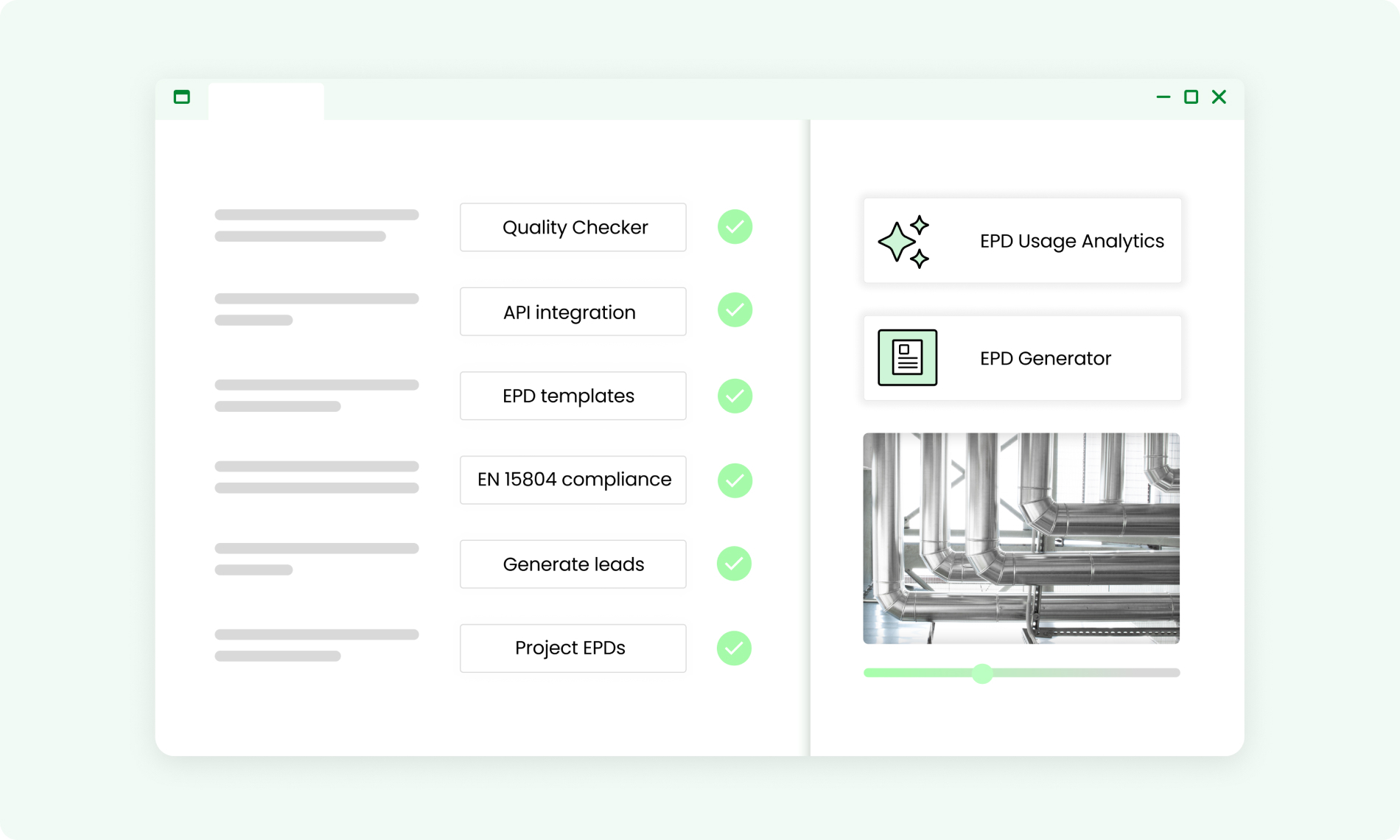
One Click LCA reads your Excel bill of materials and maps it into the model automatically, and component data you’ve already entered becomes a reusable block for the next product, so data collection is no longer a manual and repetitive process. It supports ERP integration through its API, so product data moves into your models without manual transfer. It also includes more than 500,000 datasets, ecoinvent among them, plus the world’s largest EPD database, covering more than 95% of published EPDs.
Speed to publication
4. Verification becomes a bottleneck
Your EPD is finished, then it can wait weeks for a verifier. When feedback comes back, it’s often about inconsistencies that could have been caught earlier, and your fixes go back into the queue.
Most errors should surface before the verifier ever sees the model.
5. Document export is manual and error-prone
Once the model is done, someone may still have to build the background report and the EPD document, often by copying results into a template line by line. A single transcription error can send the package back to the verifier.
Both documents should come straight out of the model, ready for verification.
How One Click LCA handles this
One Click LCA’s plausibility checker flags inconsistencies as you build, which cuts down on rework rounds, and a digital interface to EPD Hub shortens the wait for verification itself. Once the model is done, it generates the background report and the final document automatically, from templates you can adjust.
See how Vindunor cut EPD turnaround from months to days.
People and access
6. Only life cycle assessment specialists can use your current tool
Does every EPD run through the same one or two people, because they’re the only ones who know how your current software works? When they’re unavailable or overworked, new product declarations stall.
Product managers and quality teams should be able to create EPDs themselves, with specialists reviewing results instead of doing every step.
7. Licenses tie access to individual seats
A colleague at another plant needs to check a model, but your current license may not have a seat for them. Often the request goes to someone who has access, and the work waits.
Access should follow the team, not the license count.
See how Hydrotec’s team published 29 EPDs in two months without life cycle assessment experience.
Scale and flexibility
8. Every new market means a new model
Each market brings its own standards, program operators, and formats. With many EPD tools, that can mean rebuilding the model for every market. Expanding into a new region or meeting a new customer requirement turns into a project of its own.
One model should serve several markets.
9. Testing a product variant means starting over
Product development wants to know how a material substitution would change the results. In many tools, answering that question means building a new model, so the answer often comes too late to influence the design.
Ideally, you should be able to swap a material and compare results during development, while design decisions are still open.
See how OTB Materials tested material swaps to develop new low-carbon mixes.
10. Maintenance competes with new EPDs
As your portfolio grows, so does the work of keeping existing EPDs current. Updates and renewals often eat into the time your team had planned for new products.
Reusable building blocks should keep maintenance light.
How One Click LCA works
One Click LCA supports the standards and program operators used across regions, so your team adapts an existing model for a new market instead of starting over. Its modular, simulation-ready models let you test a material swap and compare results without rebuilding. And shared components carry across products, so maintenance takes less effort as the portfolio grows and each new EPD builds on the last.
What a faster EPD process is worth
Each of these signs adds time on its own. Together, they determine how many products you can bring to market backed by an EPD, how quickly, and at what cost. A faster process pays off in several ways:
- Speed to market. Products get their EPDs in time for the bids and specifications that require them, not after the window has closed.
- Lower cost per EPD. Less manual data work and fewer verification rounds mean fewer specialist hours per declaration, and the savings grow with every EPD you add.
- Less risk. Automated data mapping, plausibility checks, and pre-formatted documents cut the errors that delay verification and hold up sales.
- Growth without added headcount. When EPDs no longer depend only on one or two specialists, your portfolio can grow with demand instead of with payroll.
One Click LCA brings data collection, modeling, verification, and document generation into one platform.
EPD Generator: Get reliable & compliant third-party verified EPDs
Carbon Experts Newsletter
Industry news & insights — straight to your inbox
Resources
Keen to read more?
Read more about the topic

Melina Zacharia • Feb 05 2024

Melina Zacharia • May 06 2025
Melina Zacharia • Jul 18 2025

Asha Ramachandran • Mar 13 2024