/buildings_card-fourth.webp)
.jpg)
/menu_Company_Open-positions_card-fourth.webp)

Carbon budget as part of project management
Skanska started developing carbon footprint calculations for its building construction projects already in 2019. Since 2020, carbon footprint calculations have been mandatory for all projects where Skanska has design responsibility and are now also part of large infrastructure projects. This change was significant as it put carbon footprint calculation on the same level as cost and schedule monitoring - a basic tool for project management.
"We have made it clear that carbon footprinting is not optional for our projects, but mandatory. It is part of project management, in the same way as cost or schedule monitoring.
- Juha-Pekka Jylhä, Carbon Calculation and Low-Carbon Development, Skanska
At Skanska, carbon footprint calculations are carried out using One Click LCA, which enables a systematic assessment of the emission impact of projects at different stages and facilitates comparisons between different material solutions.
Comparison of low-carbon materials in every project
Material choices account for the largest share of emissions in construction projects. According to Skanska Finland, 95% of their total emissions come from building materials and energy consumption. For the past three years, the company has aimed to provide emission reduction assessments for all projects — even when not specifically requested by the client.
"As concrete and steel play a significant role in the emissions of both the group and the project, we try to propose low-carbon concrete and steel in particular for projects," says Jylhä.
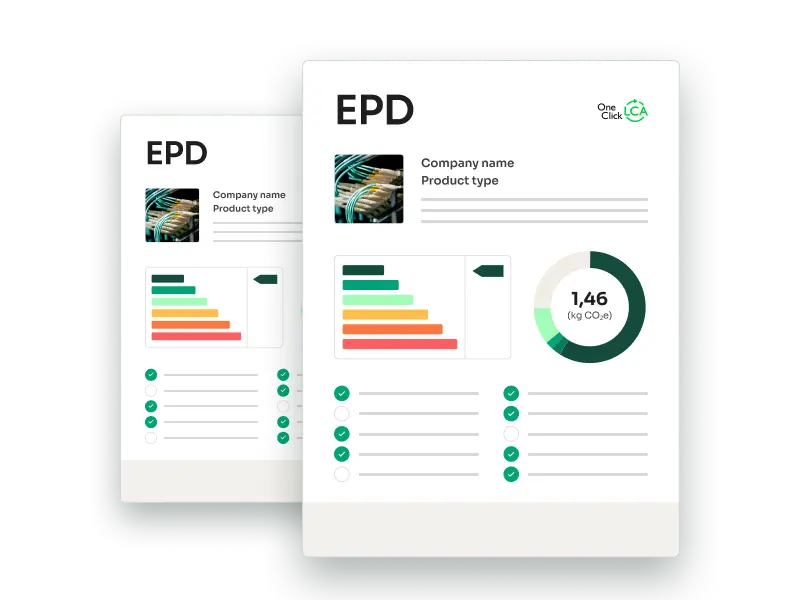
There is also a breakthrough in concrete data, as Rudus, among others, will offer EPDs for its wide range of products in the near future. The emission reduction potential of these materials will always be verified through carbon footprint comparisons.
One Click LCA's extensive database of the environmental profiles of different materials enables the emissions impact to be reliably assessed and presented to project stakeholders in a transparent manner. In this way, the use of low-carbon materials can be linked to procurement decisions and implementation based on documented information.
Materials Compass: Access 500,000+ LCA datasets in a curated construction LCA database — for consultants, designers, engineers, and procurement teams to make low-carbon choices for every project.
Involving the wider organisation in the change
Skanska has not just left carbon footprint calculation to the experts, but has spread the know-how throughout the organisation. Practical actions have included:
-
A policy to make carbon footprint calculations mandatory for all projects
-
Internal carbon footprint target levels for self-build housing
-
Establishment of a carbon footprint calculation network
-
Training of project managers
-
Appointment of experts in low carbon construction
-
Process changes, online courses and guidelines to support projects
The use of One Click LCA supports Skanska's approach by allowing project managers and designers to produce calculations themselves and use them for decision making, without leaving the calculation to the environmental team.
Concrete milestones up to 2030
Skanska aims to be carbon neutral by 2045 in all its business areas: construction services, housing, commercial and infrastructure projects. As almost all emissions are generated by material choices and energy, the most effective way to reach the target is to reduce the carbon footprint of projects. The 2025 targets are supported by concrete milestones by 2030:
-
70% reduction in own, fuel and purchased energy emissions by 2030 (compared to 2015 levels)
-
50% reduction by 2030 in own housing and facility development projects (compared to 2020 levels)
To achieve these figures, carbon footprint calculation must not be a mere reporting tool, but a mechanism that directly influences decisions. With One Click LCA, the calculation has become a key steering tool for achieving these objectives.
Ready for the 2026 Building Act
The new Finnish Construction Act, which came into force in 2025, requires the carbon footprint of a building to be reported as part of the building permit. This makes the calculation mandatory for all new buildings.
Skanska has prepared for this in advance by introducing the calculation as part of its projects. This will give the opportunity to learn how to use the calculation before the regulation comes into force and to ensure that policies are in place. "Our aim is to identify and provide the most appropriate environmentally responsible solutions for our projects. The carbon footprint calculation gives us the tools to do this," emphasises Jylhä.
One Click LCA plays a key role here: the software ensures that the calculation meets national and international standards and that the data can also be reliably reported to the authorities.