/buildings_card-fourth.webp)
.jpg)
/menu_Company_Open-positions_card-fourth.webp)

Whole life cycle analysis
HAUS WLCA: Lower-carbon housing
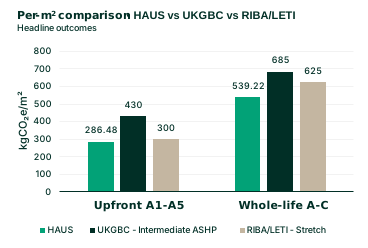
One Click LCA assessed the HAUS terrace-house demonstrator against the toughest UK industry benchmarks. Upfront carbon came in 33% below the standard and below the RIBA 2030 Stretch target.

What is the HAUS?
HAUS is a full-scale, two-storey mid-terrace house demonstrator: 110 m², bio-based, designed for rapid assembly and eventual disassembly. Built by Natural Building Systems using the ADEPT® cassette panel system, HAUS first assembled at InstallerSHOW, NEC Birmingham, in June 2025.
One Click LCA carried out a whole life carbon assessment (WLCA) compliant with EN 15978, EN 15804+A2, and the RICS Whole Life Carbon Assessment 2nd edition (2023), covering upfront embodied carbon (A1–A5), whole-life embodied carbon (A–C), and operational energy (B6) over a 60-year study period.
Key results at a glance
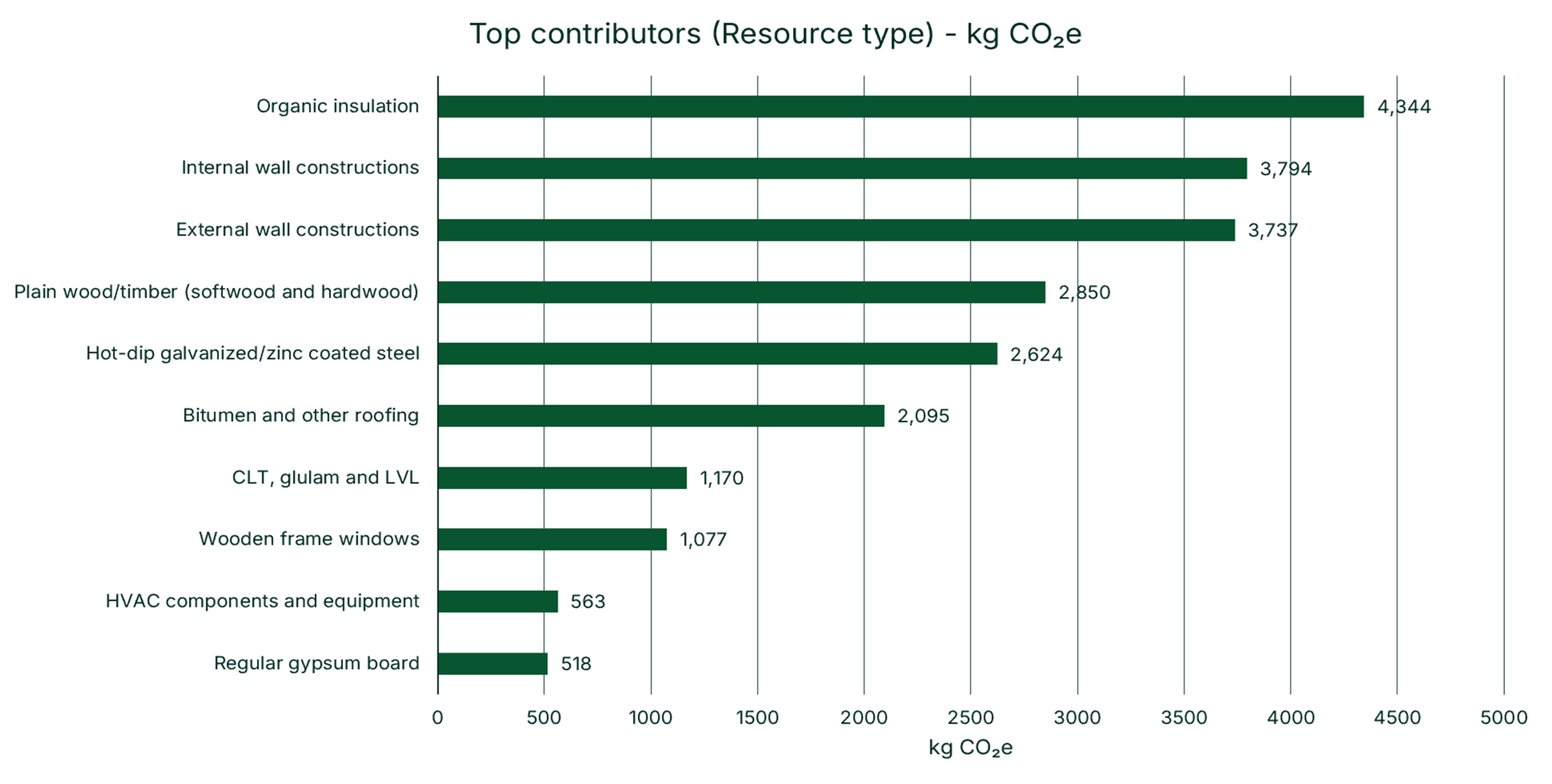
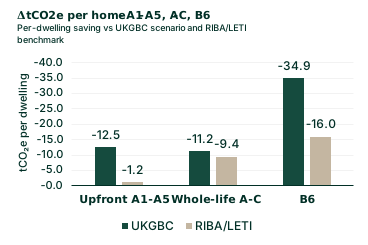
Upfront carbon (A1–A5) 286.48 kgCO₂e/m², 33% below the UKGBC Intermediate–ASHP benchmark (430 kgCO₂e/m²) and below the RIBA 2030/LETI Stretch target (300 kgCO₂e/m²). Per dwelling: a saving of approximately 12.8 tCO₂e vs. the benchmark.
Whole life embodied carbon (A–C) 539.22 kgCO₂e/m², 21% below the UKGBC benchmark (685 kgCO₂e/m²) and 14% below the RIBA 2030/LETI Stretch target (625 kgCO₂e/m²).
Operational energy (B6) 25.83 kWh/m²/yr regulated energy intensity. On-site solar PV covers approximately 78% of whole-dwelling energy demand.
Data quality 43 product-specific Environmental Product Declarations (EPDs), covering 49.44% of products by item — more than double the EPD coverage of the June 2025 study.
From InstallerSHOW to a full whole life carbon assessment
June 2025 first Life Cycle Assessment — InstallerSHOW NEC Birmingham): An initial A1–A3 cradle-to-gate assessment of a conceptual 82 m² design, with 13 product-specific EPDs. Result: 474 kgCO₂e/m², 24% below the LETI UK benchmark.
November 2025 whole life cycle assessment (WLCA) — Elemental London: Full A1–A5, B, C, and Module D assessment of the 110 m² built demonstrator. EPD coverage grew from 18 to 43 products. Updated results: 286.48 kgCO₂e/m² upfront and 539.22 kgCO₂e/m² whole life embodied.
2026 onward — University of Suffolk: Permanent installation with in-use energy monitoring against the design-stage PHPP model.
What this means for the UK housing programme
An illustrative calculation based on the whole life carbon assessment (WLCA) data: if 100,000 homes were built to HAUS's carbon performance, upfront carbon savings vs. the UKGBC benchmark would reach approximately 1,277,720 tCO₂e (A1–A5), whole-life embodied savings approximately 1,124,095 tCO₂e (A–C), and operational savings approximately 3,488,681 tCO₂e (B6) over 60 years.
These figures assume like-for-like comparison against the UKGBC Intermediate–ASHP benchmark and consistent construction methodology.
Assessment scope and standards
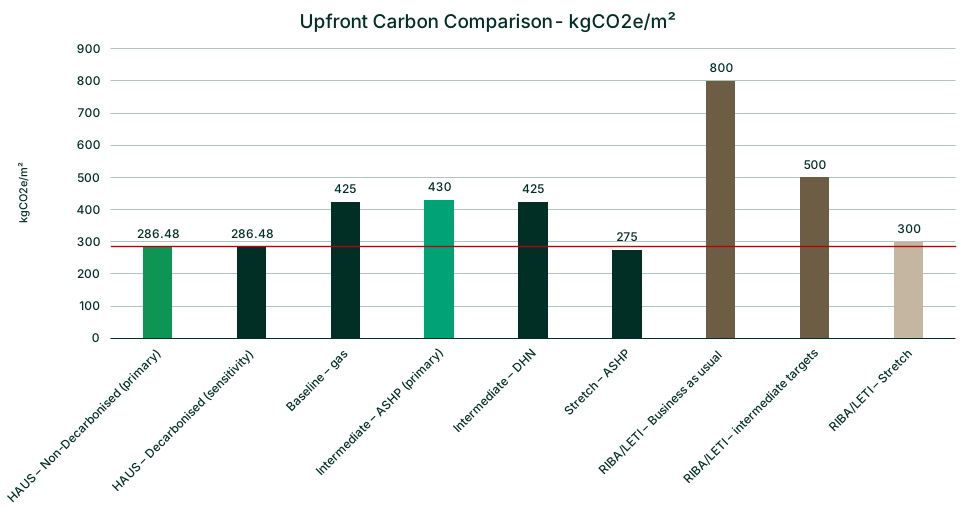
Assessed by Samuel Boswell, LCA & EPD expert at One Click LCA; internally reviewed by Marios Tsikos. Standards: EN 15978, EN 15804+A2, RICS WLCA 2nd edition (2023), ISO 14040/44, ISO 14025, ISO 21930. Functional unit: one dwelling and per m² GIA over 60 years. Module D (reuse and recycling credits) is reported separately and excluded from A–C totals. Biogenic carbon sequestered in bio-based materials: approximately 20,269 kgCO₂e/dwelling, reported separately per EN 15804+A2.
the role of epds in AEC decisions
How EPDs impact material selection in AEC
EPDs are becoming a key factor in material selection and procurement, influencing both AEC professionals and manufacturers. Their growing importance is shaping market demand and competitive positioning across regions.
Key insights:
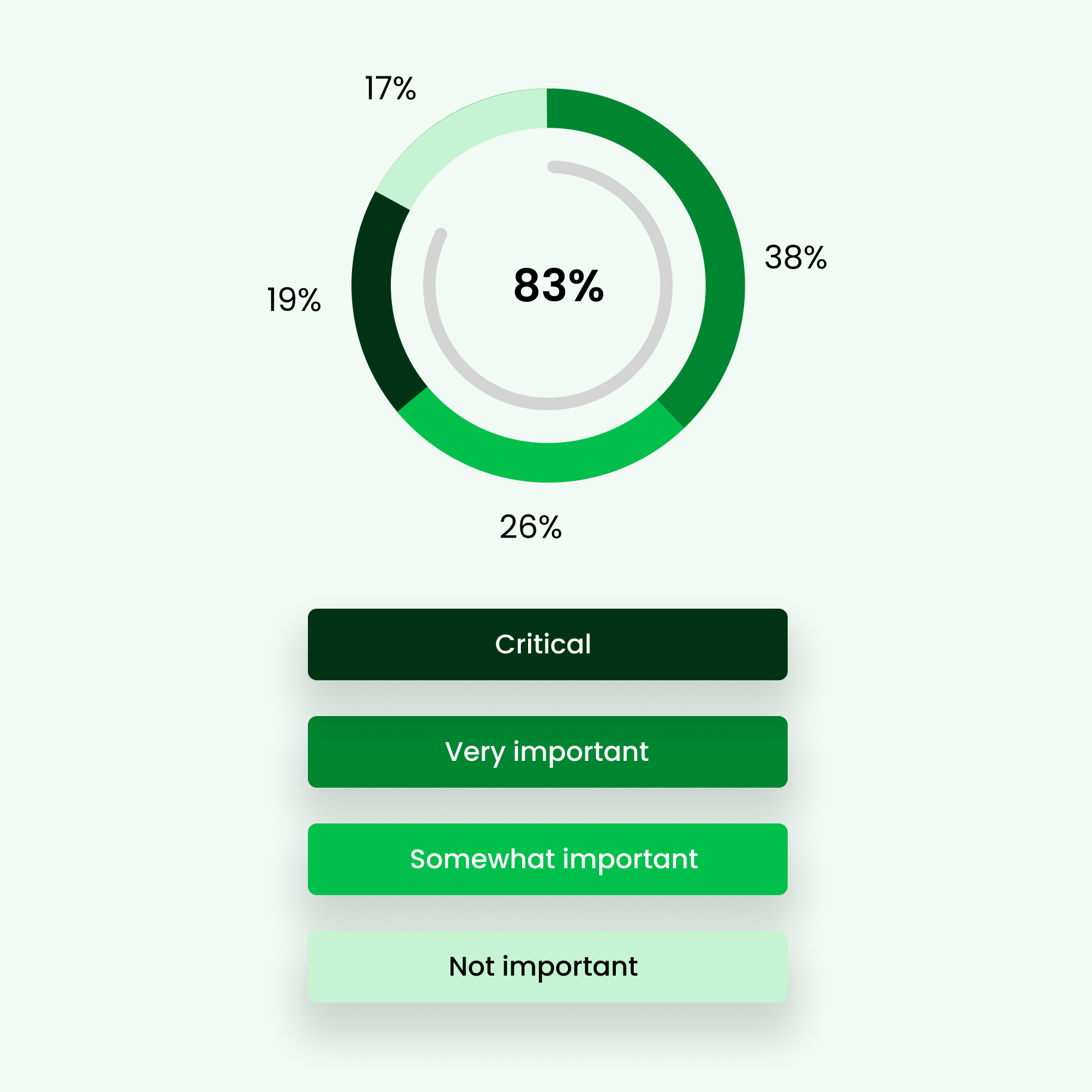
- 83% of AEC respondents report that EPDs influence material selection in building projects.
- 38% consider EPDs very important, while 19% regard them as critical to their decision-making process.
- Only 17% of respondents do not consider EPDs important, indicating that the vast majority recognize their value in material decisions.
Key challenges for manufacturing
Top barriers to LCA and EPD adoption in product development:
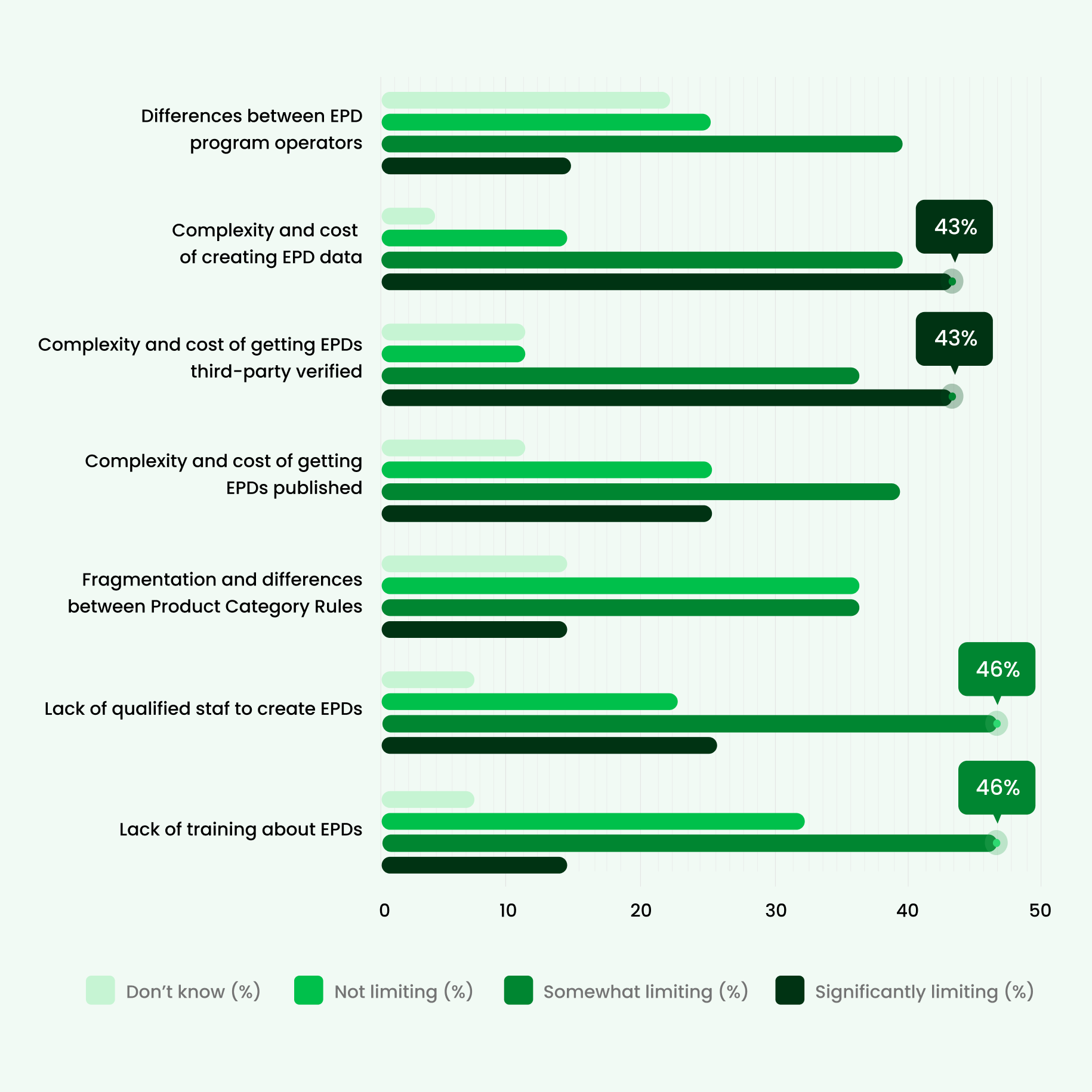
- Over 80% of manufacturers identify the high cost and complexity of EPD creation and verification as the biggest barriers.
- Many manufacturers struggle with the financial burden and technical requirements of producing EPDs, including verification and staff shortages, which limit the number of verified declarations available for material selection.
Carbon reduction potential
Carbon reduction potential in manufacturing
The report demonstrates measurable progress in reducing embodied carbon through building LCAs, as well as product LCAs and EPDs, alongside growing confidence among professionals.
Key insights from product development:
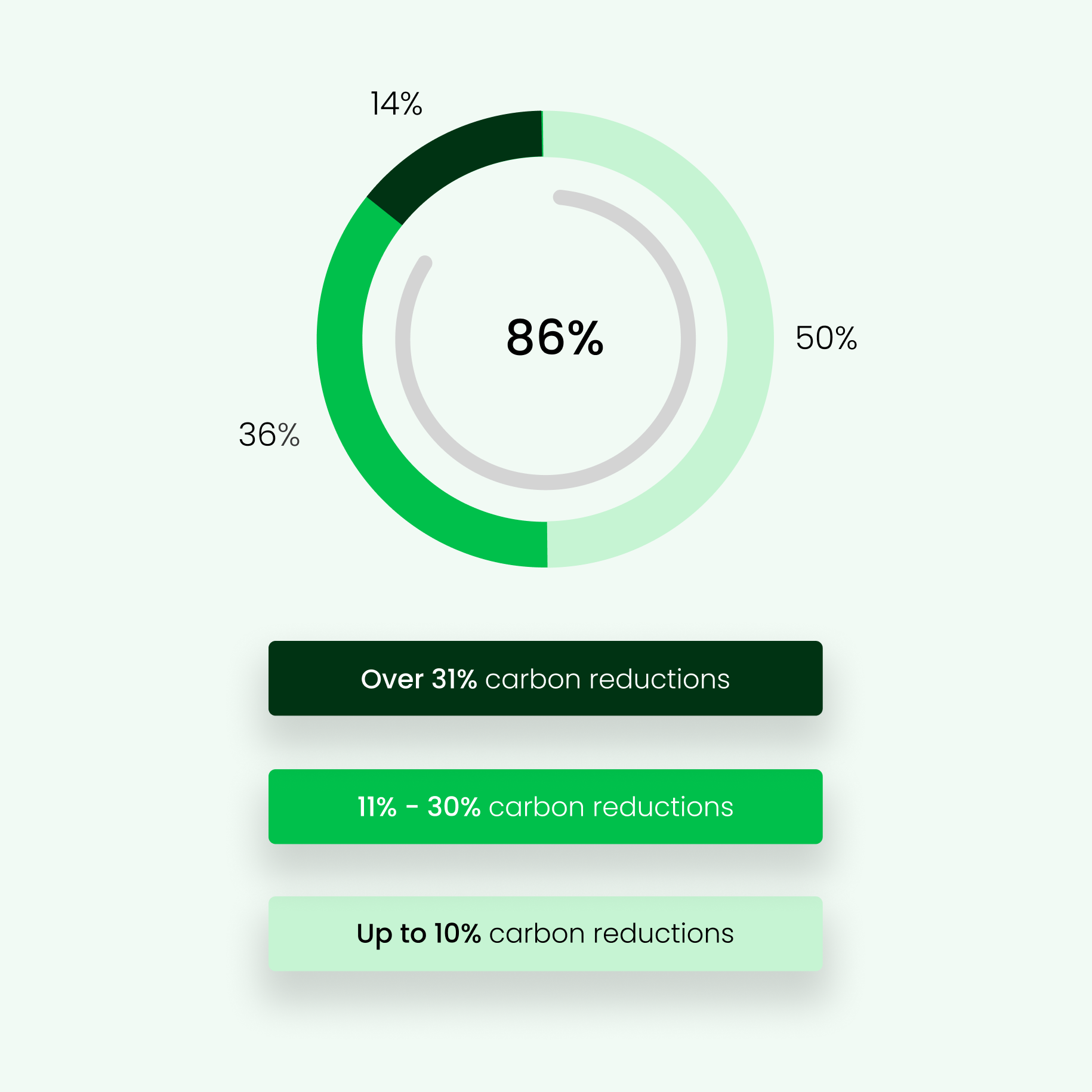
- 86% of manufacturers anticipate carbon reductions of up to 30% by applying insights from LCA in their product development processes.
- Within this group of manufacturing experts, 50% expect reductions of up to 10%, while 36% are targeting reductions between 11%–30%.
Download the full carbon report for more insights.
Carbon reduction potential in AEC
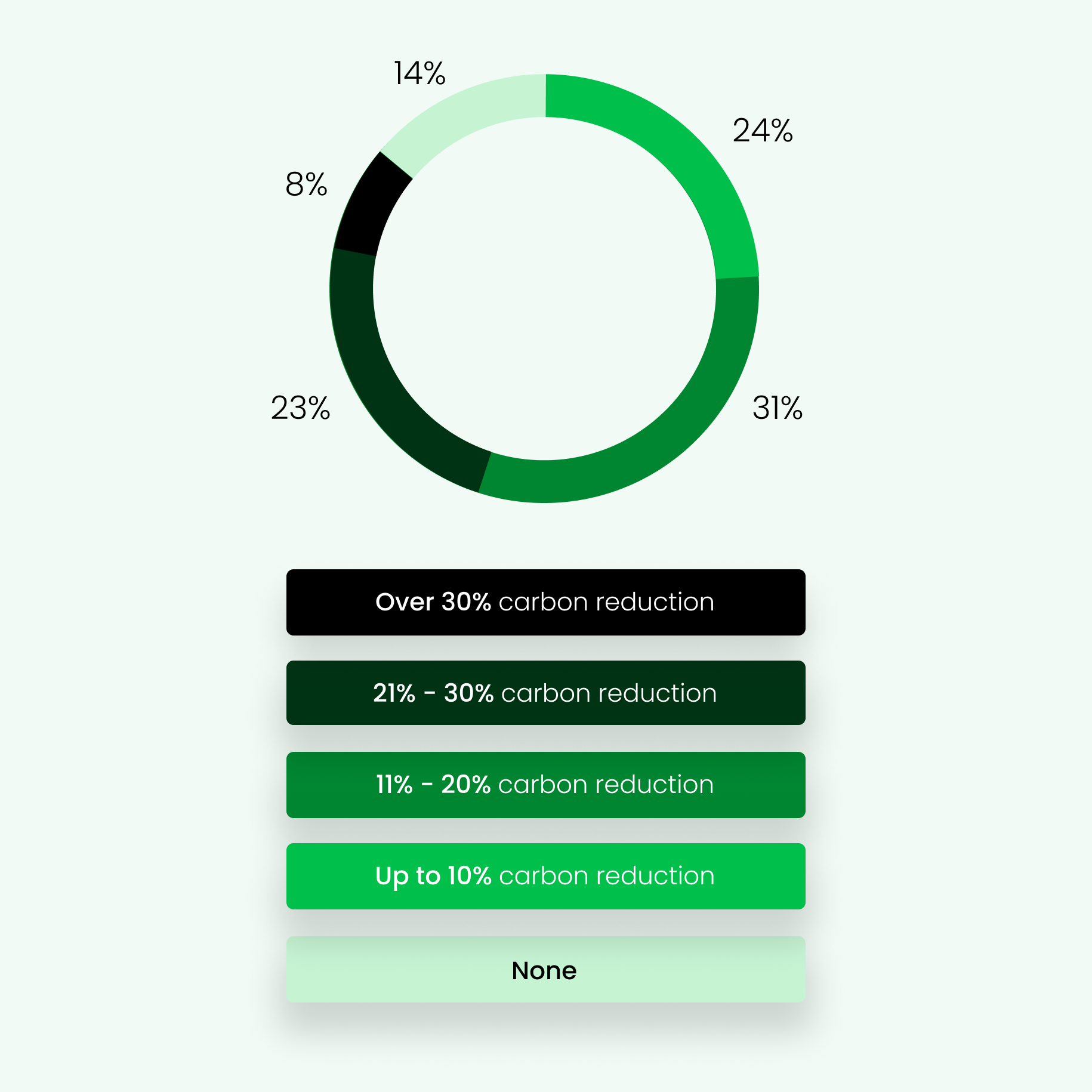
The results, based on surveyed AEC professionals, highlight the significant potential of life-cycle assessments (LCAs) to reduce embodied carbon in construction.
Key insights from construction LCAs:
- 31% of AEC respondents report achieving embodied carbon reductions of up to 20% through construction LCAs.
- Over 60% estimate reductions of at least 10% in embodied carbon.
Get the full report for insights into carbon reduction potential across AEC disciplines.
EPD demand to grow ‘significantly’
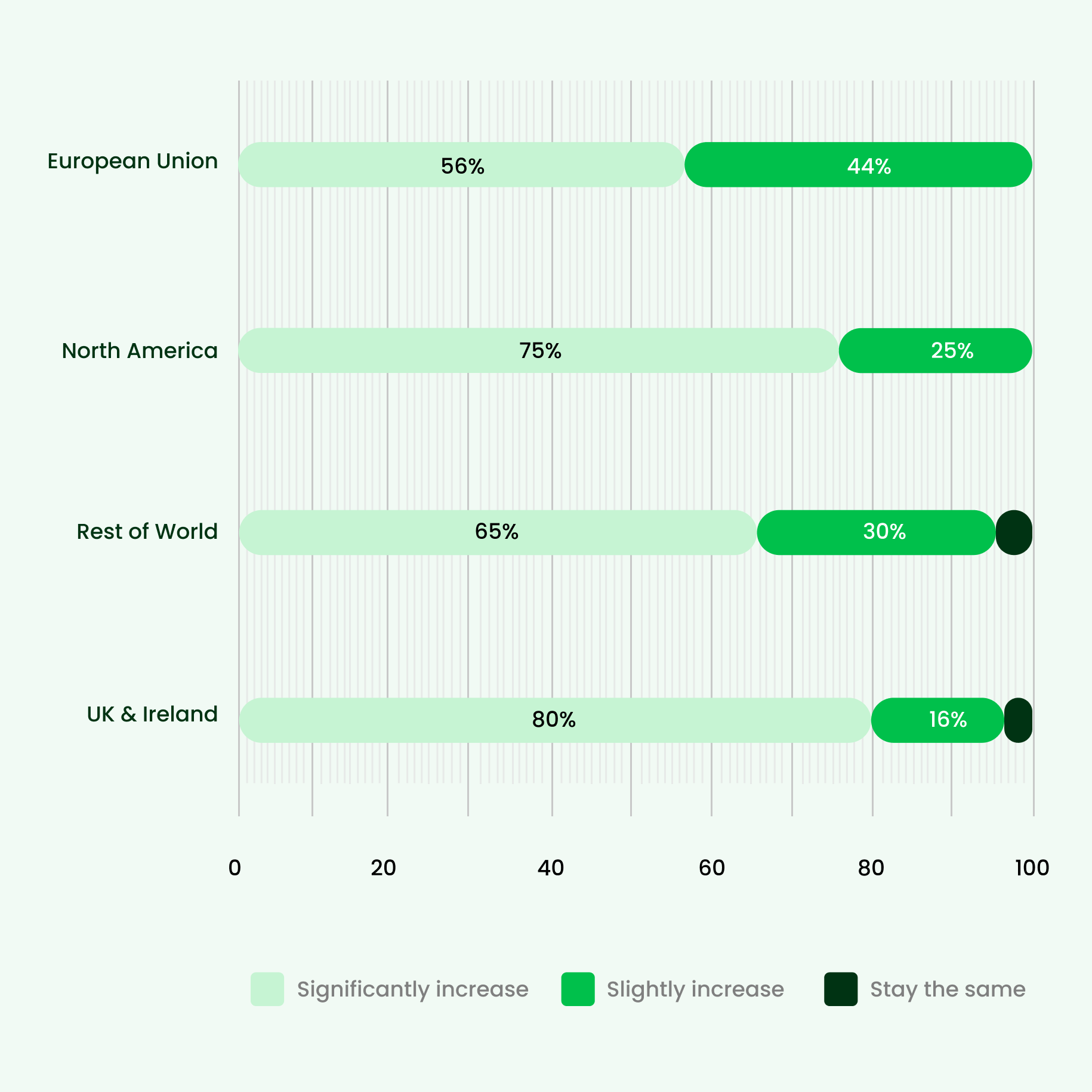
Both AEC and manufacturing respondents from all surveyed regions anticipate growing demand for EPDs over the next three years. Notably, 100% of respondents in every region expect EPD demand to either increase significantly or slightly.
Key insights:
- 80% of respondents from the United Kingdom and Ireland expect a significant increase in EPD demand within the next three years.
- 75% of North American respondents predict that demand will increase significantly within the next three years.
- 65% of respondents from the Rest of the World expect a significant increase in EPD demand, with an additional 30% anticipating a slight increase.
Download the 2025 report
Get the full report for more insights & data
What you'll find in the full 2025 Carbon Experts Report:
- Detailed regional breakdowns of carbon reduction potential across AEC disciplines and manufacturing sectors.
- Future construction trends, including how automation and digital tools are transforming LCA processes and reducing time and costs.
- Insights into material data gaps in areas like concrete, MEP systems, and steel.
- Regulatory landscape and policy recommendations to support decarbonization at national and regional levels.
- 31 detailed graphs — backed by data from nearly 150 industry experts.

Learnings & opportunities
Insights and opportunities for manufacturers
- EPDs for market growth: With 83% of AEC professionals factoring EPDs into material selection, manufacturers must treat EPDs as strategic assets. Ensuring accessibility, quality, and comparability of EPDs will not only improve procurement success but also enhance competitive positioning. Leveraging automation can scale up EPD creation and reduce costs, making compliance and market entry smoother.
- Adapting to regulations: New regulations such as the EU’s CPR and CBAM are setting higher standards for environmental transparency. Manufacturers who act now — by generating verified EPDs and improving data transparency — can gain early-mover advantages, ensuring compliance while positioning themselves as sustainability leaders.
- Driving industry-wide collaboration: Data fragmentation remains a key barrier, slowing LCA adoption and limiting EPD effectiveness. Collaboration with AEC professionals and suppliers to close data gaps and improve LCA reliability will help overcome this challenge.
Insights and opportunities for AEC professionals
- Maximizing LCA for carbon reduction: Over 60% of AEC respondents report at least a 10% embodied carbon reduction using LCA, with a third achieving up to 20%. Implementing LCAs across all project phases and pushing for lower-carbon materials consistently can unlock even greater reductions.
- EPDs as a core procurement tool: With 83% of AEC professionals considering EPDs critical, prioritizing materials with verified EPDs will drive market shifts toward transparency. Establishing clearer benchmarks and demanding standardized EPDs from suppliers will strengthen material selection frameworks.
- Strengthening manufacturer collaboration: Major data gaps remain in materials like concrete and MEP systems. Working directly with manufacturers to improve data availability and streamline information-sharing will advance reliable environmental assessments and accelerate decarbonization goals.