/buildings_card-fourth.webp)
.jpg)
/menu_Company_Open-positions_card-fourth.webp)

RESOURCE HUB
The essentials of EPDs
Understand what Environmental Product Declarations and product carbon footprints mean for your business, from regulatory requirements to tender wins.
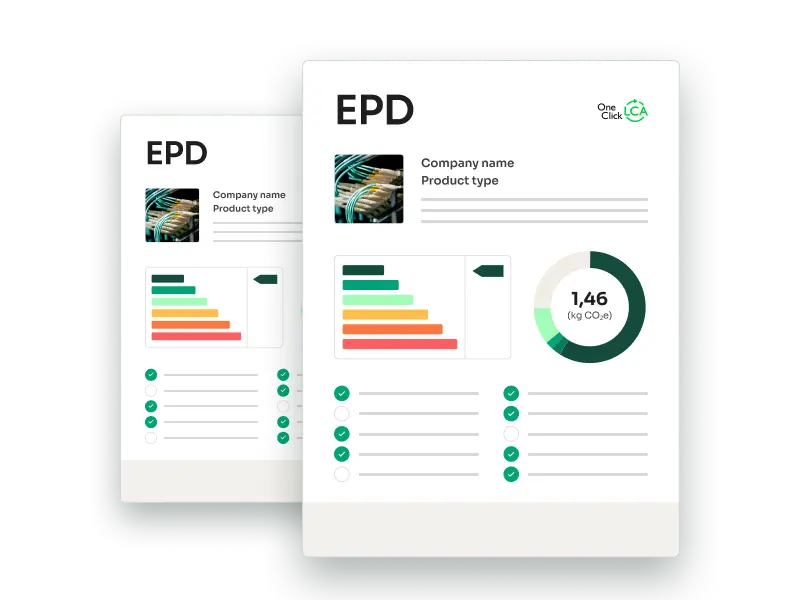

What is an EPD?
An Environmental Product Declaration reports the verified environmental impact of a product across its life cycle. It's based on independent standards such as EN 15804.

EPD vs. carbon footprint vs. LCA
A life cycle assessment is the underlying study. A product carbon footprint reports one impact category, carbon. An EPD is the standardized, third-party verified document built from that study, covering multiple impact categories.

Verified vs. pre-verified EPDs
A verified EPD is checked by an independent verifier for a single product. A pre-verified EPD is also independently verified, but it's built on a calculation tool the program operator has already verified, so verification of each EPD is faster. That cuts time to publication for manufacturers producing similar products at scale.
Benchmark your global warming potential with EPDs
See 10 EPD examples for steel, concrete, and other construction products.
.png)
CPR
What it is
The Construction Products Regulation (CPR) sets harmonized rules for placing construction products on the EU market. The revised regulation expands requirements to include structured environmental data alongside technical performance.
Who it affects
All manufacturers placing construction products on the EU market — including non-EU manufacturers exporting into the EU.
Why it matters
CPR compliance determines legal market access. Increasingly, verified environmental data and standardized product information influence specification, procurement, and competitive positioning.
Timeline
Regulation entered into force — January 7, 2025

CBAM
What it is
The Carbon Border Adjustment Mechanism (CBAM) introduces carbon pricing and emissions reporting requirements for certain carbon-intensive products imported into the EU.
Who it affects
EU importers of covered goods — and manufacturers supplying products such as cement, steel, aluminum, and other emission-intensive materials.
Why it matters
Importers require reliable product-level emissions data. Manufacturers unable to provide verified carbon data risk cost exposure, commercial disadvantage, or reduced market access.
Timeline
Regulation entered its definitive phase — January 1, 2026

ESPR
What it is
The Ecodesign for Sustainable Products Regulation (ESPR) establishes a framework for sustainability, circularity, and product information requirements across multiple product categories.
Who it affects
Manufacturers placing regulated products on the EU market, including construction-related materials and components.
Why it matters
ESPR will progressively define what environmental data must be disclosed and structured — shaping future Digital Product Passport requirements and procurement expectations across EU supply chains.
Timeline
Regulation entered into force — July 18, 2024

CSRD
What it is
The Corporate Sustainability Reporting Directive (CSRD) establishes mandatory sustainability reporting under the European Sustainability Reporting Standards (ESRS), requiring in-scope companies to disclose environmental, social, and governance impacts, including value chain emissions.
Who it affects
Large EU companies and EU-listed issuers with more than 1,000 employees and over €450 million in net turnover, and non-EU parent companies with more than €450 million in EU-generated turnover — plus their upstream suppliers, who face growing requests for verified environmental data.
Why it matters
CSRD reporters need reliable data on their suppliers' environmental performance to meet value chain disclosure requirements. Manufacturers that can provide verified EPDs and product carbon footprint data are better positioned to meet these requests and retain business with CSRD-reporting customers.
Directive entered into force — January 5, 2023

Best EPD and product LCA software of 2026
Overview of top EPD software platforms to create EPD certificates for products and materials.
Webinar: How to gather data for your EPD
Watch and learn, step by step, what a real EPD data gathering workflow looks like.
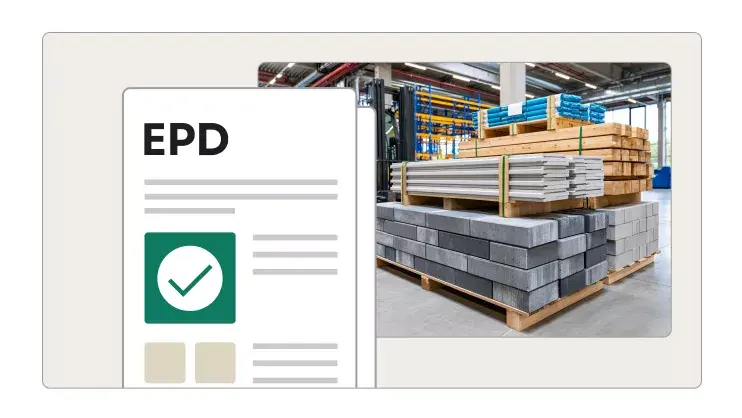
One Click LCA's EPD generator
Create EPDs faster, across your entire portfolio.

How specifiers use EPDs to select building materials
Learn how specifiers, architects, and designers use EPDs for material selection in building projects.

Webinar: How to get more value from your EPDs
Learn how TimberHP approached its first EPD while preparing to scale production.
%20(1).jpg)
Case study: Sightline Commercial Solutions gets ahead with EPDs
Read how the manufacturer started winning more projects with EPDs.
90% of your clients prefer products with EPDs
And 97% of construction professionals expect demand for EPDs to keep growing. EPDs are the most recognized source of truth about the real impact of specific products and materials. Their availability and rigor determines whether construction projects can effectively lower their carbon impact and differentiates product offers.

.jpg)
Polycare achieves 70% lower carbon with its first EPD
"Switching to One Click LCA was a strategic decision to internalize the EPD creation process, build up our own expertise, and reduce external dependencies."
Philipp Scherer
Head of Materials & Sustainability at Polycare

Blue Marble simplifies 5,500 components into 5 EPDs
"An EPD is not just a tick-box for compliance. It’s a strategic asset that unlocks tenders, informs clients, and drives product improvement. When built correctly, it pays back far more than it costs"
Sam McGarrick
Head of Advisory at Blue Marble

Firth Steels reduces steel carbon by 74%
"For Firth Steels, almost all of our carbon footprint sits in Scope 3, so the biggest lever for change is the steel we specify and source"
Sam Hopton
Head of technical at Firth Steels
EPD Generator
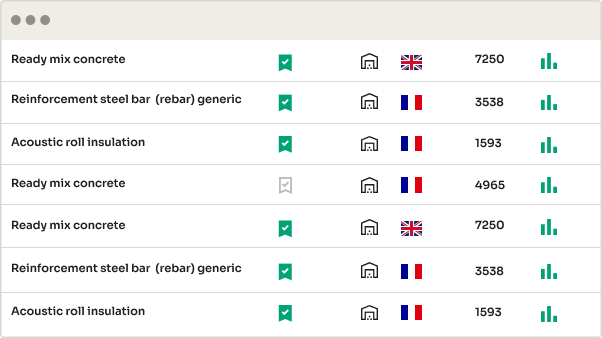
Create verified EPDs for any product across any industry. Produce EPDs ready for third-party verification, generate private EPDs, and perform TM65-compliant calculations while supporting CPR and ESPR requirements.
Luminaire EPD Generator
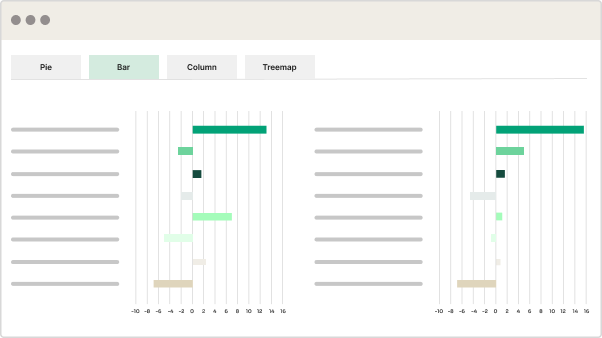
Generate EPDs for luminaires using lighting-specific templates and component datasets. Streamline EPD preparation for third-party verification while supporting TM65 calculations and EU regulatory requirements.
Concrete EPD Generator
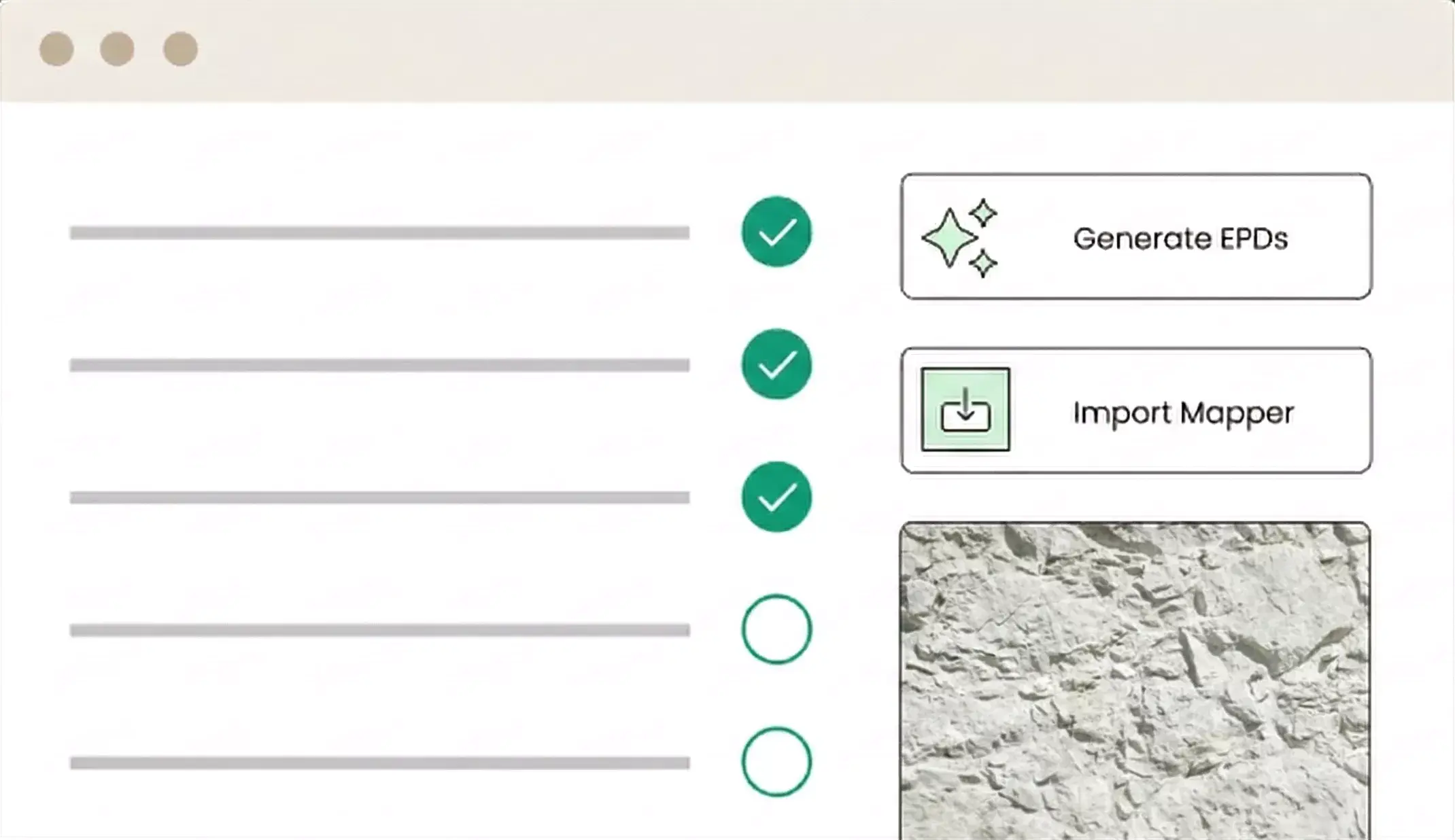
Develop EPDs for concrete mixes using ready-to-use templates aligned with industry standards. Prepare EPDs for third-party verification while meeting EN 15804 requirements and concrete product reporting needs.
Product carbon footprint
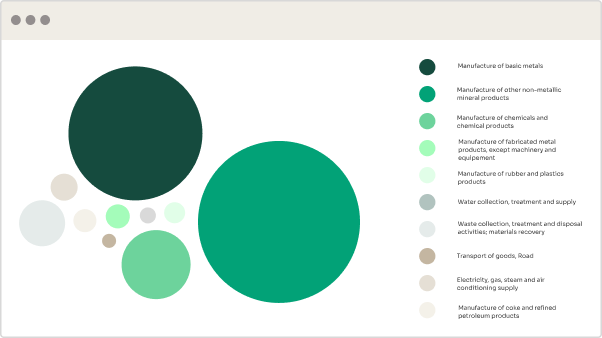
Measure and report product emissions from cradle-to-grave with the Product carbon footprint (PCF) tool. Calculate carbon footprint and comply with ISOs 14040, 14044, 14067, CBAM and EN 15804.
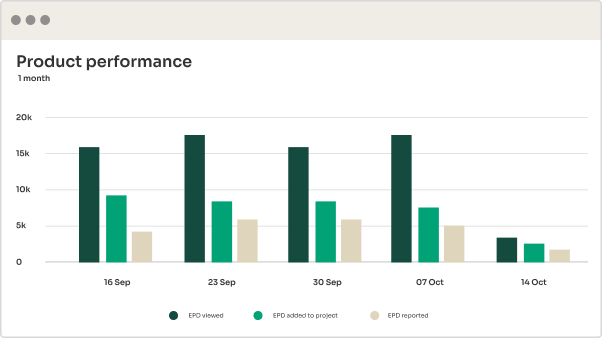
EPD Usage Analytics
Track and analyse how your EPDs perform, giving you a clear view of metrics like the number of views and the level of interest your products are generating.
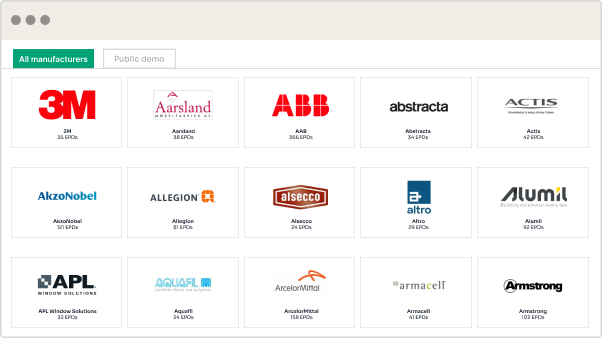
Manufacturer pages
Get your products in front of AEC professionals through a database of over 500,000+ LCA datasets. Help specifiers and buyers find your EPDs and get specified.