/buildings_card-fourth.webp)
.jpg)
/menu_Company_Open-positions_card-fourth.webp)


What do we mean by generic materials data?
One Click LCA produces generic materials datasets required for life cycle assessment (LCA), including environmental impact data for key materials used in construction such as concrete, steel, wood, glass, plastics and electronic components. Generic materials datasets represent average data across an entire industry sector or product category and are a calculated estimate, rather than a specific measurement for a single product.
Why do we produce generic materials datasets?
At One Click LCA, we understand that specific and local data for a particular construction material might not always be available and that you still need high-quality data to complete the life-cycle assessment (LCA) for your project.
We produce generic materials datasets to provide you with a reliable alternative when product or manufacturer-specific information is not available, e.g. in the form of Environmental Product Declarations (EPDs).
How do we produce generic materials datasets?
One Click LCA creates generic materials datasets with two different processes:
-
Calculated average generic data based on EPDs published by manufacturers.
-
Generic data modelled bottom-up using standard product LCA methodology.
Calculated average generic data based on EPDs published by manufacturers
Calculated average datasets are statistically derived from valid, third-party verified Environmental Product Declarations (EPDs) for comparable products within a defined region. This approach aligns with established practices used by regulators worldwide.
These datasets are designed to represent the environmental profile of a typical product and are developed at varying levels of granularity by manufacturing country and product category. To enhance accuracy and reliability, outlier EPDs with atypical impact values are excluded from the analysis.
The resulting robust datasets provide reliable proxy values for filling data gaps when product-specific EPDs are unavailable. One Click LCA has developed such calculated average data for most countries where EPDs are available.
Generic data modelled bottom-up using product LCA methodology
Bottom-up modelled generic datasets are developed using the same principles as Environmental Product Declarations (EPDs), by defining the bill of materials and manufacturing processes. In place of primary factory data, One Click LCA analysts compile information from publicly available sources, such as product datasheets, technical documentation, scientific LCA studies, and other credible references.
The environmental impacts of the identified material components are modelled, where applicable, using widely available or customised life cycle inventory (LCI) data, as well as existing generic datasets, including those developed by One Click LCA.
These generic datasets are created using EPD software and undergo a rigorous quality assurance process prior to publication. This includes automated benchmarking against existing datasets within the world’s largest construction LCA database.
Step-by-step process to produce bottom-up generic materials datasets
When producing generic materials data at One Click LCA, we follow a rigorous four-step process to ensure quality, accuracy, and transparency.
1. Sourcing upstream and quantitative data
One Click LCA analysts gather information from publicly available sources, including product datasheets, technical documentation, scientific LCA studies, and other credible references. The first stage is to identify and collect all relevant data on the material inputs used during the manufacturing phase. Figure 1 below shows an example of data collected for the development of a generic dataset for a lime-stabilised rammed earth wall.
The next stage is to determine the energy required for product manufacturing and final assembly, as well as any auxiliary materials and direct emissions associated with the process.
.png?width=541&height=233&name=image%20(43).png)
Figure 1: Input-Output life-cycle assessment (I/O) inventory model used for lime stabilized rammed earth wall. “Life cycle analysis of environmental impacts of earthen materials in the Portuguese context: Rammed earth and compressed earth blocks”, Jorge Fernandes et al. 2019
In most cases, we combine data from multiple sources for a more comprehensive and detailed model. If information is missing, we fill the gaps with data for sufficiently similar products.
2. Modelling with EPD creation software
We create the model for the generic material once all input data, input processes, input and output material and elemental flows have been obtained. The model incorporates all collected data on material inputs and energy consumption. The generic material is modelled using One Click LCA’s EPD creation software and the modelling approach is aligned with EPD development, although it relies on secondary rather than primary factory data. One Click LCA’s modelled generic materials datasets always cover A1–A3 (cradle-to-gate) only.
In some cases, certain impacts are not included in the model calculation due to a lack of available source data. We provide clear explanations of any assumptions or exclusions made during data creation in the dataset description.
When commercially available, the modelled construction products come in a variety of shapes and sizes, as well as with or without additive materials. This variation depends on a multitude of factors, including the economic or trade region. We seek to model our generic materials to be representative in as many commercial areas as possible.
3. Review and internal verification process
The LCA data expert responsible for modelling the specific generic material in question is supported by a team of experienced peers throughout an internal quality assurance process to ensure model quality, accuracy and transparency. First, the manufacturing model and resulting environmental impacts are reviewed as a stand-alone case to verify calculation logic and completeness of data. The expertise of the LCA data team at One Click LCA is critical in ensuring the high quality and reliability of this manual review and verification phase.
Second, the resulting environmental impacts are benchmarked against other LCA data. This is conducted using an internal, automated benchmarking feature in One Click LCA software for EPD creation where the environmental impacts of the new generic materials are compared against impacts of other materials, both identical and with similar characteristics within the same material category. Benchmarks use manufacturer EPDs, other generic materials datasets and calculated industry averages based on data published anywhere in the world. Critical to the performance and reliability of this automated benchmarks-based verification process is the world’s largest construction LCA database at One Click LCA.
4. Publishing and availability
Once the review process is complete and data quality has been confirmed, the generic material is published and becomes available in the One Click LCA database. You can now find the data in our software for both design & construction and manufacturing.
In most cases, One Click LCA generic materials include environmental impact indicators as required by major regulations, standards and Green Building Councils (GBC) across the world so you can find it via the materials search feature in most of our tools - subject to the specific rules applicable to the use of generic data in the relevant tool.
One Click LCA generic materials typically include environmental impacts for all commonly used standards and impact assessment methods such as EN 15804+A2, EN 15804+A1, TRACI, ISO 14040, ISO 14044 and ISO 21930. They also typically include additional indicators as required by specific Product Category Rules (PCR) and EPD programs globally, including International EPD System, INIES France, Boverket Sweden and EPD Norge.
The published generic material description provides information about the dataset and source data. It also provides transparent explanations about any assumptions or exclusions made during data creation.
Frequently Asked Questions (FAQ)
Why are the environmental impacts different in a One Click LCA generic material compared to an EPD for a similar product?
One Click LCA generic materials are modelled to be usable globally, representing average production methods and technology. For this reason, material and energy inputs are global and not specific to your country. This is a conscious choice to make One Click LCA generic materials both available globally and conservative in terms of environmental impacts. In other words, you can expect somewhat higher environmental impacts from a One Click LCA generic material than from an actual EPD applicable to your country.
Can I request One Click LCA to produce generic materials data for my LCA projects?
Yes. You can contact our Customer Success team to request the development of new generic material datasets for your LCA projects.
We always welcome feedback, ideas, and requests. The production of high-quality generic data depends on the availability of credible background information, and all requests are evaluated and prioritised based on the needs of our global customer base.
In some cases, you may also commission the development of generic datasets as a paid service. Our Customer Success team will be happy to advise you on available options.
If you already have specific data you wish to use, you can add it directly to your company account as Private data via the user interface. This feature is available to all Expert licence users, with detailed instructions provided in the One Click LCA Help Centre.
Find, compare & choose low-carbon construction materials
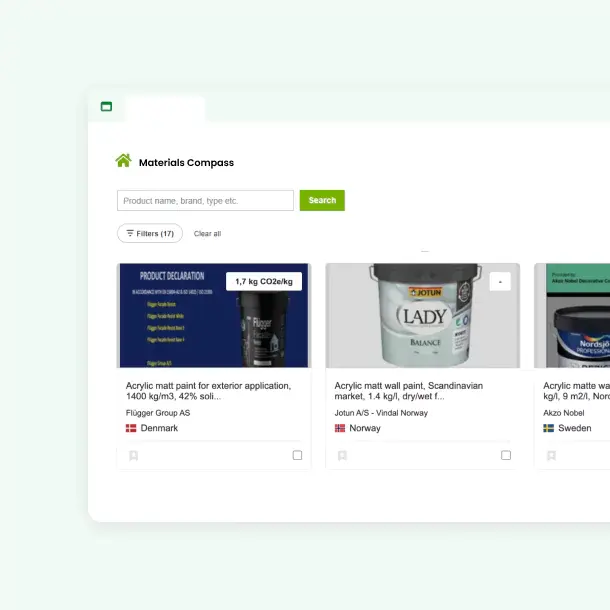
The Materials Compass from One Click LCA is designed to help construction professionals cut carbon in their projects & achieve sustainability goals by finding, comparing, and choosing the most sustainable building materials.