/buildings_card-fourth.webp)
.jpg)
/menu_Company_Open-positions_card-fourth.webp)

Whole-life carbon reporting becomes mandatory across Europe
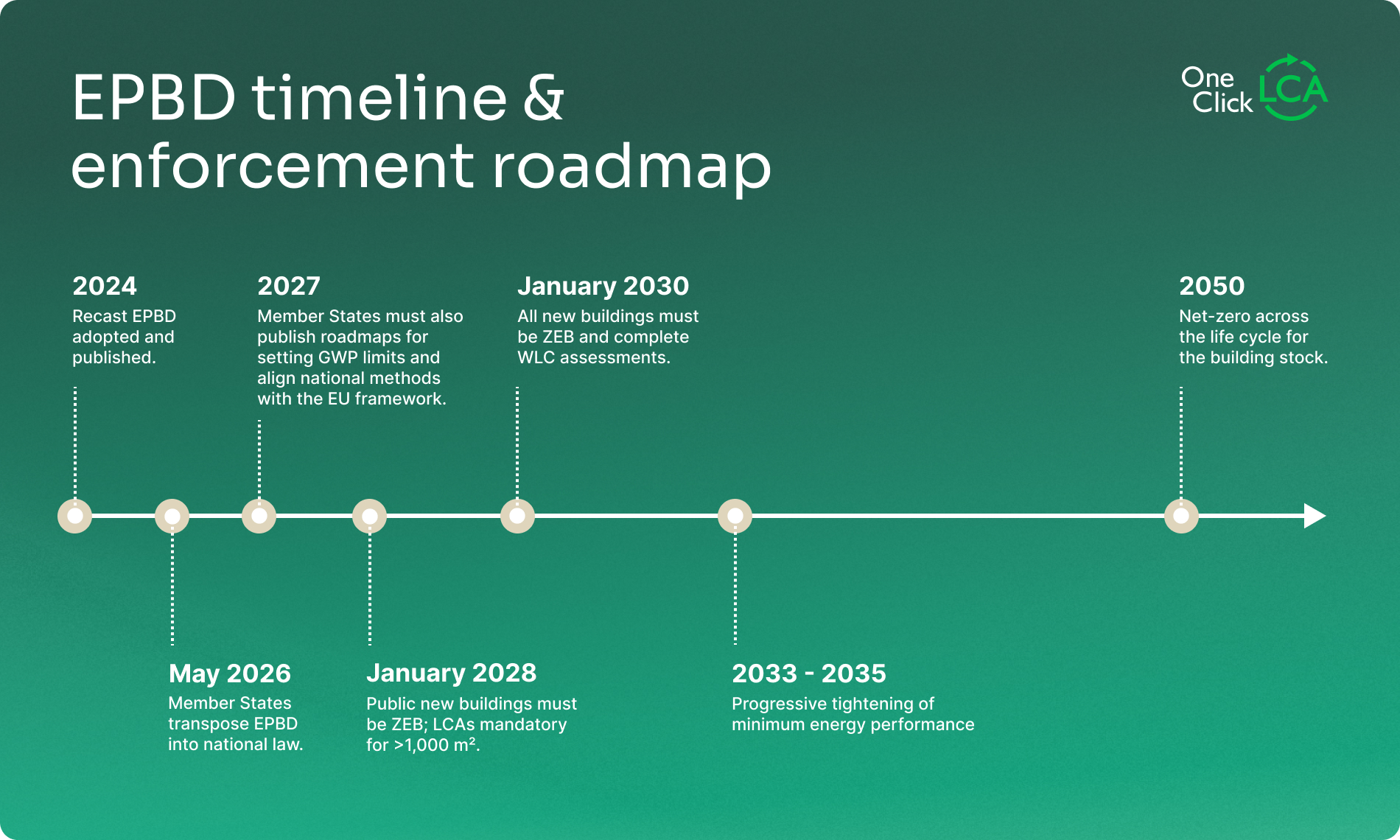
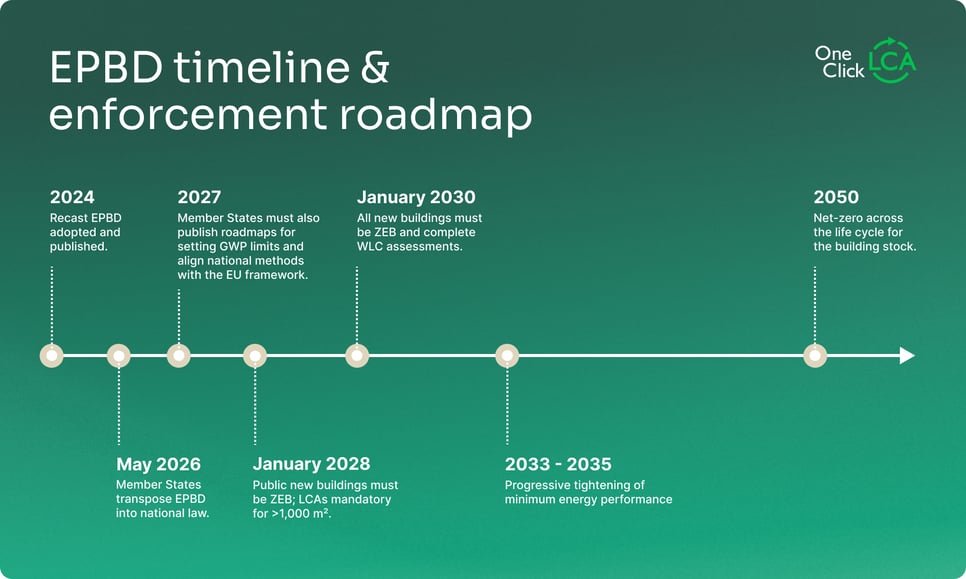
The revised EPBD makes whole-life carbon reporting mandatory for new buildings across the EU. Member States must transpose the directive by May 2026, with requirements applying to buildings above 1,000 m² from 2028 and to all new buildings from 2030. Projects must calculate and disclose full life-cycle Global Warming Potential (GWP), which will appear on the Energy Performance Certificate. National carbon thresholds will follow and are expected to tighten over time, influencing feasibility, permitting, and financing.This regulatory direction is reflected in major international frameworks. For example:
- LEED v5 requires LCA as part of each project’s decarbonization plan, with credits available for reducing embodied carbon.
- BREEAM v7 requires LCAs at concept, technical, and post-construction stages for higher ratings.
- RICS v2 provides standardized rules for buildings and infrastructure, covering biogenic carbon, future grid scenarios, and benchmarking aligned with the International Cost Management Standard, third edition (ICMS 3).
Whole-life carbon reporting for AEC teams
The shift from operational to whole-life carbon expands the technical workload for architects, engineers, and consultants. Three themes dominate current practice:-
Mandatory reporting: LCA becomes a baseline requirement for permitting and compliance.
- Earlier design interventions: Decisions made before detailed design have the greatest influence on embodied carbon.
- Consistent data and quality assurance: Regulators and certifiers expect transparent, reproducible results.
How One Click LCA supports whole-life carbon reporting
Below is a summary of the latest capabilities added to One Click LCA to align with emerging regulatory, certification, and client requirements.
1. Future-proof compliance across markets
One Click LCA includes tools aligned with the latest frameworks, including RICS v2 for infrastructure, LEED v5, and BREEAM v7. This helps design teams generate compliant results without manual rework. Benefits for AEC teams include:- Alignment with EPBD, national LCA requirements, and global certification systems
- Reduced rework during submissions
- Lower risk of audit queries or non-compliance
- Consistent outputs across countries, business units, and project types
2. Early-stage decarbonization with AI-supported concept design
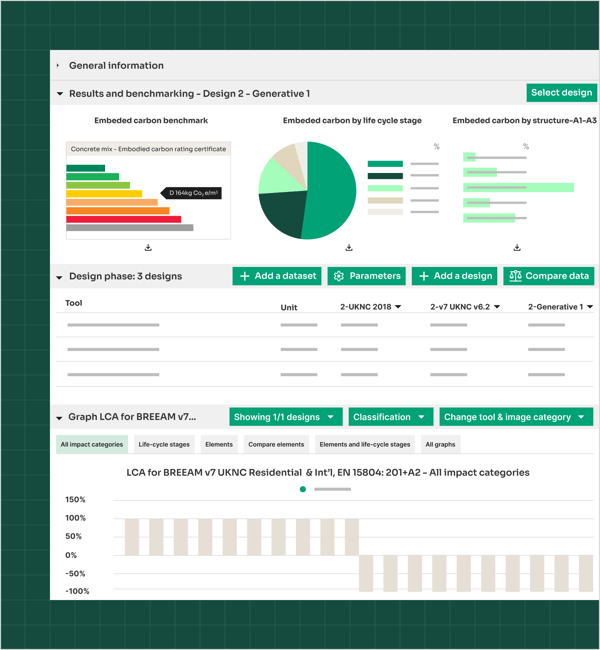
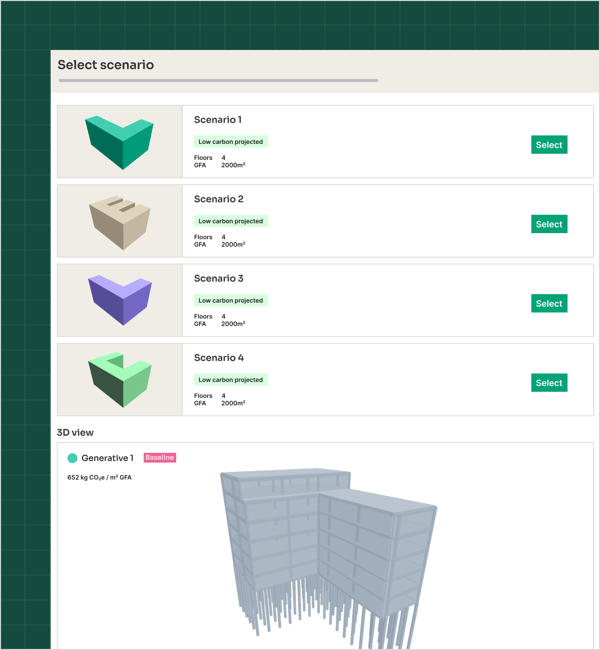
Whole-life carbon limits increase the importance of decisions made before specifications or BIM models exist. Carbon Designer 3D addresses this by enabling early-stage modeling, testing, and comparison of massing options. Key updates improving early design decisions include:- Free Drawing: converts a sketched floor plan into a full 3D model. This accelerates feasibility assessment and reduces dependence on early BIM inputs.
- Generative Design: creates multiple massing options based on project and site constraints. It provides carbon estimates for each option, helping design teams select lower-impact approaches at the concept stage.
- Expanded predefined shapes: new L- and E-shapes (adjustable to F, U, and T geometries) reflect common building typologies and improve early-stage scenario coverage.
- Identify carbon hotspots early using predefined or freehand geometries
- Estimate embodied carbon before detailed models exist
- Compare structural systems, materials, and massing options
- Assess feasibility against site, height, area, and regulatory constraints
3. Faster, more accurate BIM-to-LCA workflows
IFC files are widely used for sharing geometry, quantities, and classifications across BIM platforms. Reliable IFC imports are essential for consistent LCA results. One Click LCA’s embedded IFC viewer and data importer streamline this workflow. Users can preview models, extract quantities, and map objects to environmental profiles with visual confirmation.
Key updates — visual 3D mapping
The IFC viewer is integrated into the data-mapping step. Selecting a row in the table highlights the corresponding elements in the 3D model — and vice versa. This reduces the risk of incorrect mappings or missing elements.
Key benefits:
- Model inspection with zoom and filtering
- Instant quantity extraction into a bill of materials
- Automated fallback logic using IFC metadata
- Reduced mapping errors through element-level visualization
- Higher-fidelity material quantities and improved embodied-carbon accuracy
For large AEC organizations, these updates support consistent modeling practices, reduce manual corrections, and improve audit readiness.
4. AI-assisted material selection
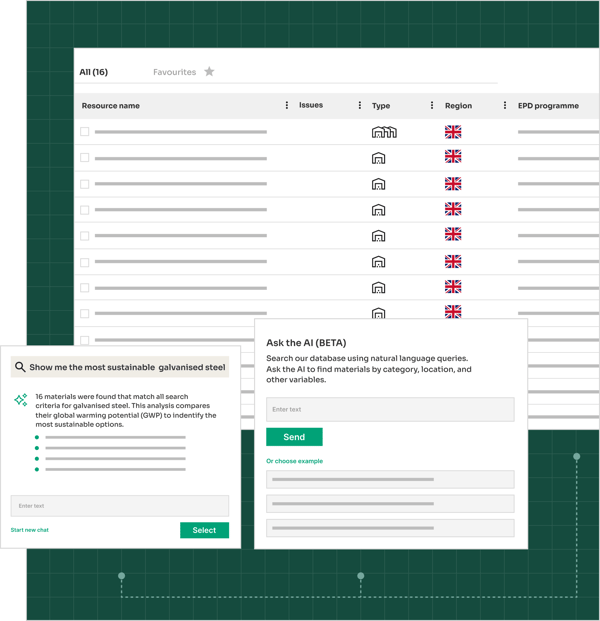
Material choices are a major driver of embodied carbon. The new AI chat tool interprets natural-language queries and searches across thousands of datapoints to identify suitable materials within the project context. It considers location, relevant standards, tool settings, and query history.
Key benefits:
- Identifying low-carbon alternatives
- Finding average or typical materials
- Listing materials from a specific country
- Filtering for manufacturer-specific products
5. AI-supported validation for credible reporting
Regulators and certifiers increasingly expect transparent and accurate LCA results. The updated Plausibility Checker provides more comprehensive and customizable checks using AI. It can evaluate more variables and adapt to project- and scheme-specific requirements.
Results are benchmarked using the Carbon Heroes dataset, which applies a fixed scope (Modules A1–C4, 60-year period, new construction). Some tools are excluded due to methodological differences. This strengthens audit readiness and reduces the risk of errors that could affect compliance, tenders, or financing.
6. Portfolio-level carbon and ESG tracking
EPBD and CSRD reporting requirements mean organizations must monitor carbon at portfolio scale. Portfolio Analytics centralizes project-level LCA results and connects them with One Click LCA’s environmental datasets.
Key benefits:
- Consolidated visibility into the full project portfolio
- Performance tracking against decarbonization targets
- Benchmarking against industry data and regulatory limits
- Identification of improvement opportunities
- Analysis of material use and EPD adoption across projects
- Exportable tables and charts for reporting and disclosures
This shifts LCA from a project deliverable to an organizational capability.
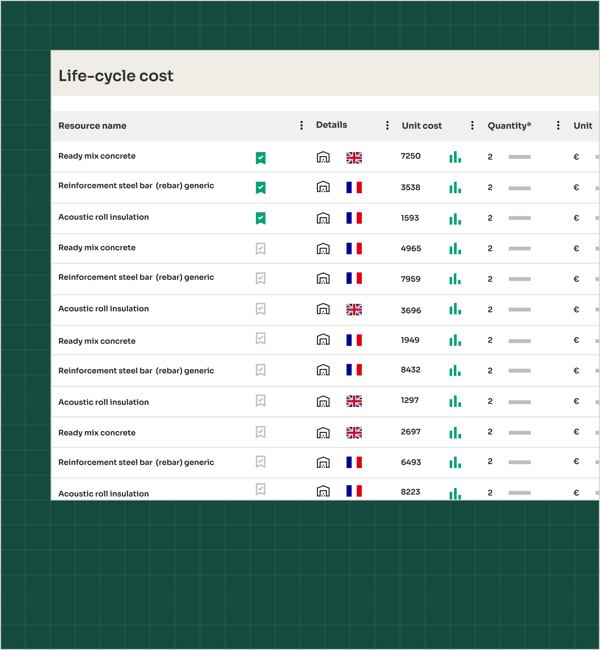
7. Integrated life cycle cost analysis
Clients and funders are increasingly interested in both environmental and financial performance. One Click LCA’s new Life Cycle Costing module runs alongside carbon assessments with shared data structures.
Key benefits:
- Compare cost and carbon simultaneously
- Model inflation, discount rates, and labor assumptions
- Assess cost implications of low-carbon alternatives
- Support transparent value engineering
8. Productivity improvements across the full workflow
Calculation speeds are now up to ten times faster, filters have been redesigned to improve usability, and material search now includes location and popularity filters.
For multi-office AEC organizations, this helps standardize LCA practice and reduce the operational cost of compliance.

FAQ — Frequently asked questions about whole-life carbon reporting
With EPBD Level(s) and BREEAM v7 requirements, how can One Click LCA help me stay compliant without duplicating work?
You can add multiple tools to the same project and use one design to calculate results for all required certifications. If small differences in requirements arise, you can copy the design and adjust only the parameters that differ. In most cases, a single set of inputs produces the required outputs for embodied carbon, circularity, cost, and certification reporting.
How does the AI-based data recommendation service determine which LCI data or EPDs are accurate or compliant?
The AI assesses the project’s location, initial inputs, and design data. It compares these against anonymized data from thousands of similar designs in the platform and recommends the datasets most commonly used in comparable projects that follow the same standards and regional conditions.
If AI flags an outlier in my results, can I override it or view how the expected range was calculated?
Yes. The checker displays the estimated range. You can override the value if it differs from project conditions. After saving the change, the plausibility score is recalculated.
Will the faster BIM-to-LCA workflows support the tools we already use, such as Revit?
The new IFC import workflow — including the embedded 3D viewer — is already available. You can view the 3D model while mapping resources. The IFC files can be exported from various BIM and 3d design tools like Archicad, Tekla, Vectorworks, Solidworks etc, therefore by using the IFC Viewer you can support LCA for many tools
Revit workflows remain supported through the current plug-in or Revit models can also be exported to IFC format for direct 3d model connection with One CLick LCA platform.
What about California’s CALGreen code?
One Click LCA supports CALGreen compliance with a dedicated CALGreen tool.
Considering that LEED v5, BREEAM v7, and RICS v2 all require Whole Life Carbon assessment, what are the principal methodological challenges in achieving comparability across frameworks?
Because One Click LCA supports 140+ standards, a perfect one-to-one comparison is rarely possible. Each framework has differences in scope and data requirements. When the assessment scope is aligned across frameworks, comparability becomes more straightforward, but full equivalence is not achievable.
How does Carbon Designer 3D support sustainability certifications?
Carbon Designer 3D results inform early-stage decisions that align with LEED, BREEAM, DGNB, and Level(s) methodologies. Optimizing carbon at concept design helps reduce embodied impacts through later project phases.
How does Generative Design differ from Free Drawing in Carbon Designer 3D?
Generative Design uses AI to generate multiple optimized shapes based on site and design constraints. Free Drawing allows you to draw a custom shape manually for full design flexibility.
Can I modify a generated model after creating it in Carbon Designer 3D?
Yes. You can adjust materials, quantities, or building elements after calculation. However, geometric dimensions cannot be changed once areas are calculated and the 3D model is finalized.
What are the IFC schema version requirements for the IFC Viewer?
The IFC Viewer supports IFC 2x3, IFC 4, and IFC 4.3. Functionality is largely consistent across schema versions for typical building models. Newer schema versions often include more structured information — such as materials, geometry, and quantities — and support more element types.
Who can access Portfolio Analytics?
Portfolio Analytics is available to enterprise and AEC customers with eligible One Click LCA licenses. Contact sales@oneclicklca.com to confirm eligibility.
Does Portfolio Analytics support benchmarking?
Yes. The dashboard includes comparison tools that allow benchmarking against industry averages, One Click LCA’s Carbon Heroes datasets, and applicable regional benchmarks.